

Ant Smuggling for Big Money: How ‘Pet Ants’ Became a Global Business
- Published By: Tech Team
- September 2, 2026 / 11:00 AM IST


Human progress has come a long way. There was a time when people saw ants at home and immediately closed the sugar jar. If there were too many, they used insect spray. But times have changed. Today, people are flying across countries to find rare ants, buying them, carefully placing them inside small plastic tubes and even hiding them in luggage to move them across international borders.
Human civilisation invented the wheel, built airplanes and created the internet. After all that progress, we have somehow reached a point where ants too have an international market.
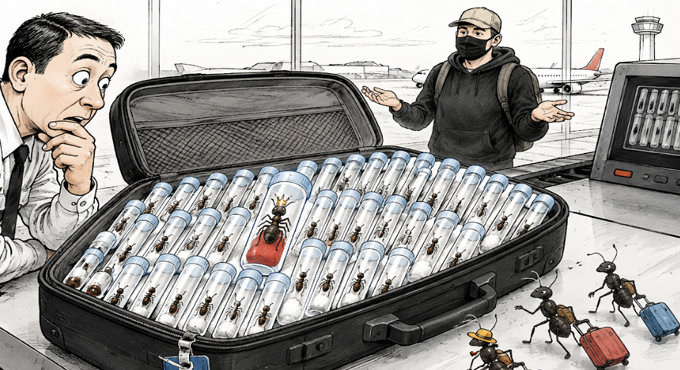
At Nairobi airport, officials opened a man’s luggage expecting to find gold, drugs or some other expensive contraband. Instead, they found 2,200 ants. Not just a handful, but thousands of them, carefully packed inside small plastic tubes with damp cotton placed inside to help keep them alive during the journey.
The ants had no passports, visas or tickets. But they had something perhaps more valuable in this case: a market overseas.
If you are wondering whether ants can really be in such high demand, the answer may surprise you. These were not just ordinary ants. Some species can sell for hundreds of dollars on the black market, while collectors around the world actively search for rare varieties. The ant that we casually sweep away at home can become a luxury pet somewhere else. That is where the strange world of pet ants begins.
Why Are People So Interested in Ants?
For many people, keeping dogs, cats or fish is completely normal. For others, keeping ants has become just another hobby. And they are not keeping one or two ants simply for fun. Some enthusiasts maintain colonies containing hundreds or even thousands of ants.
These colonies are housed inside specially designed transparent containers. Watching them can feel like looking at a miniature underground city. The ants dig tunnels, search for food, return to their nests and slowly expand their colonies. To someone looking from the outside, it may seem difficult to understand the attraction. What exactly is there to watch?
But for ant enthusiasts, this is entertainment.
Watching a queen ant establish a new colony, seeing thousands of ants divide their work and observing the construction of new nests can feel like a live series unfolding in real time. For them, this is their version of Netflix.
The Real Star Is the Queen Ant
The figure of 2,200 ants may sound impressive, but smugglers are not necessarily interested in the number of ants. What they really want are queen ants.
In the ant world, the queen is not just another member of the colony. In a way, it is the CEO, factory owner and future planning department all rolled into one. A single queen can establish a new colony and eventually produce thousands of worker ants.
That is why African harvester queen ants, which may cost only a few dollars in Kenya, can reportedly sell for more than $200 on overseas black markets. The ants wandering around freely in our homes may appear worthless, but the right species can suddenly become surprisingly valuable.
It also raises an interesting question about value itself. Does something become valuable because of what it can do, or simply because it is rare? The global market for rare ants seems to have given that question a rather unusual answer.
Ant Keeping Has Also Become a Fashionable Hobby
The growing interest in ant keeping received another push during the pandemic, when people spent long periods at home looking for new hobbies. Some learned cooking, some started growing plants and others took up yoga.
Then there were those who decided to start an ant colony.
What began as an unusual hobby grew further with the help of social media. Today, there are communities dedicated to ants, collectors searching for rare species and enthusiasts who can spend hours watching the life of a single colony.
So far, there is nothing particularly unusual about that. But when people become deeply interested in a hobby, the next step is usually predictable. A market emerges. As the market grows, prices rise. And when prices rise, smugglers eventually find their way in.
So, Smugglers Are Now Interested in Ants Too?
That is exactly what makes this story so strange. When we think about wildlife trafficking, we usually imagine elephant ivory, tiger skins or rare birds. Ants rarely come to mind.
But they have now entered the world of wildlife smuggling too.
In the Nairobi case, the ants were packed inside small plastic tubes, with damp cotton placed inside to keep them alive during transport. This was not a case of ants accidentally crawling into someone’s luggage. The arrangement clearly suggests a planned attempt to move them across borders.
It was, in every sense, a complete travel arrangement—except perhaps for the tickets.
But Does It Really Matter If These Ants Are Taken Away?
This is where the amusing side of the story becomes more serious. An ant may be a tiny creature to us, but it is not a small thing for an ecosystem.
In grasslands, ants play an important role. As they move around in search of food, they help collect and disperse seeds. By digging tunnels underground, they also help air reach the soil and create conditions that can support plant growth. Ants are also food for many other animals.
So, the creatures being packed into suitcases and transported across borders are not simply thousands of tiny insects. They are small workers helping to support a much larger ecological system.
Taking a Queen Ant Can Cause an Even Bigger Problem
Smugglers are particularly interested in queen ants because they can make money from them. But that is also where the ecological problem becomes more serious.
A queen ant can live for decades and produce a colony consisting of thousands of workers. Taking one queen away, therefore, is not simply about removing one small insect. It is about removing the possibility of an entire future colony.
In a sense, it is like emptying a small city before it has even been built.
Humans have already cut down forests to build homes. Now, for the sake of hobbies and collections, we are taking ants out of the wild too. Nature must have a great deal of patience with us.
This Is Only One Case
The Nairobi incident involving 2,200 ants is not the only case. In another incident, two teenagers were reportedly caught carrying around 5,000 ants.
That naturally raises another question: how many others may have crossed borders without being caught?
Once smugglers discover that there is money in something, they tend to behave a little like ants themselves. Close one route, and they will simply look for another.
From Pest to Pet, Depending on the Price
In the end, the strangest part of this entire story may not be the ants. It may be us.
When ants appear in our homes, we call pest control. When we find them in the wild, some people put them into suitcases. When they reach foreign markets, they become pets. And when their price rises, they are suddenly described as rare wildlife.
Perhaps that is the real story behind the global pet-ant business.
The ants have not changed. We have.
— Surya Prakash Josyula
Related News

Why Did Elon Musk Name His Son ‘Sekhar’? The Story of the Great Indian Scientist Behind the Name

When AI Talks About God, Whose Side Is It On?

Trump’s New Visa Move Could Put Indian Women’s Careers in America at Risk

Credit Card Holder Dies: Who Pays the Outstanding Bill?

Can a Person Really Disappear? The Mystery of ‘Maya’ Through Vivekananda’s Explanation