

American AI Behind China’s Military Weapons? The Shocking New Power Game!
- Published By: Tech Team
- August 1, 2026 / 10:45 AM IST


— Surya Prakash Josyula
“Communication Down!”
The alarm suddenly echoes through the control room.
Contact with the battlefield has been completely lost. The radar is no longer working. GPS signals have disappeared. The commander’s instructions are not reaching the drone. Yet, high above the battlefield, the drone keeps flying.
For a few seconds, everyone falls silent.
The mission is assumed to be over. But the drone doesn’t stop. It studies every movement on the ground through its own cameras. It identifies the target, decides when to attack, and acts within seconds. No human is giving it orders. It is making decisions using its own AI.
Until recently, this was something you would expect to see only in a Hollywood science fiction movie. Today, however, military researchers around the world are working toward exactly this kind of battlefield. And that raises a bigger question.
Where did this intelligence come from?
That is the real twist in this story.
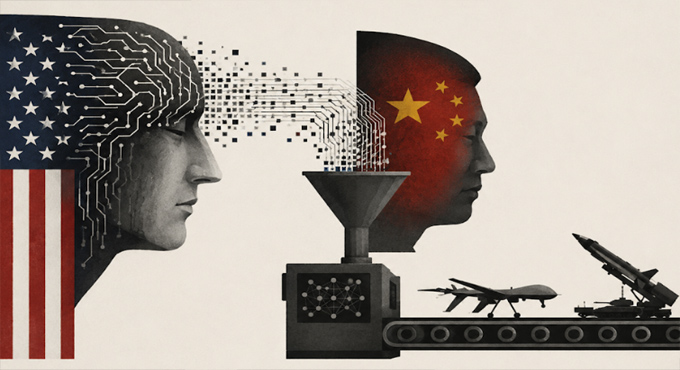
An American Brain, A Chinese Mission. The world’s most advanced AI models were built in the United States.
Companies like OpenAI and Anthropic trained their systems using enormous amounts of books, research papers, documents, and data. These models learned how to analyze information, reason through problems, and generate detailed answers.
According to research papers reviewed by Reuters, Chinese researchers are now trying to adapt some of those capabilities for their own military AI systems.
China is not simply installing American AI inside its military. That would be extremely difficult. Instead, it is taking a different path.
Learning From the Teacher
Imagine a student learning from a brilliant teacher.
The student watches how the teacher solves difficult problems. Later, the student goes home and develops his own method using what he has learned.
That is essentially what AI researchers call model distillation.
Instead of copying the original AI model itself, researchers use its outputs and reasoning patterns to train a smaller domestic AI model. The goal is not to duplicate American AI but to build a Chinese model that can perform similar tasks while operating entirely inside China’s own systems.
Reuters reviewed more than 80 Chinese research papers and patents that describe the use of this approach.
What Happens Next?
This is where the story becomes even more important.
Chinese researchers are not trying to build another chatbot.
They are trying to build AI that can support military operations.
A paper from China’s National University of Defense Technology describes efforts to compress powerful AI capabilities into smaller models that could eventually run on military drones.
The objective is clear.
If communication networks collapse during a war, if GPS fails, or if commanders lose contact with their drones, those drones should still be able to analyze live video, identify targets, navigate independently, and continue their mission without waiting for human instructions.
That represents a major shift in how future wars could be fought.
Why America Is Worried
Many observers compare this situation to the idea of unintentionally creating your own future challenge.
The United States led the global AI revolution. American companies invested billions of dollars to build the world’s most advanced AI systems.
Now, researchers linked to China’s military appear to be studying the capabilities of those systems and adapting similar techniques for China’s own military AI development.
This does not mean American companies intentionally helped China’s military. However, it highlights how advanced AI knowledge can spread beyond its original creators and become part of a much larger geopolitical competition.
Xi Jinping’s Goal
Chinese President Xi Jinping has made his objective clear.
He wants China to build an “intelligent military system” by 2027. Artificial intelligence, autonomous drones, unmanned military technologies, and AI-powered decision-making systems are expected to become central parts of China’s future armed forces.
That is why the research papers reviewed by Reuters have attracted so much international attention.
Why the World Is Concerned
Traditional weapons can be counted.
Nuclear warheads can be monitored.
Missiles have measurable ranges.
Artificial intelligence is different.
Once advanced reasoning techniques are learned and adapted, similar capabilities can appear in new models, new countries, and new military systems.
That is why many experts believe the global competition over AI may become even more important than the traditional arms race. In tomorrow’s wars, the biggest question may no longer be who fires the first missile. It may be who has the smartest AI making the first decision.
Conclusion
Artificial intelligence was welcomed as a technology that could improve everyday life.
It promised better healthcare, smarter education, higher productivity, and new scientific breakthroughs.
Those promises still remain.
At the same time, AI is beginning to reshape military strategy and global security.
The Reuters findings suggest that China is working to learn from the capabilities demonstrated by leading American AI models as it develops more advanced military AI systems of its own.
The future of warfare may not be decided by which country has more tanks or more soldiers.
It may be decided by which country builds the most capable AI.