
AI Sensation in Telangana Fields! World Bank’s Mind-Blowing Report!
- Published By: Tech Team
- August 10, 2026 / 05:20 PM IST


— Surya Prakash Josyula
When we hear about AI, we usually think of huge amounts of data, billions of dollars in investment, and Silicon Valley giants like OpenAI and Google. The world is busy competing over whose AI model is bigger, who has more computing power, and who can build the most advanced technology. But the World Bank’s World Development Report 2026 has offered a very different lesson.
And this story did not begin in a high-tech laboratory in America. It began in the fields of Telangana.
A Small AI Tool That Saved $560!
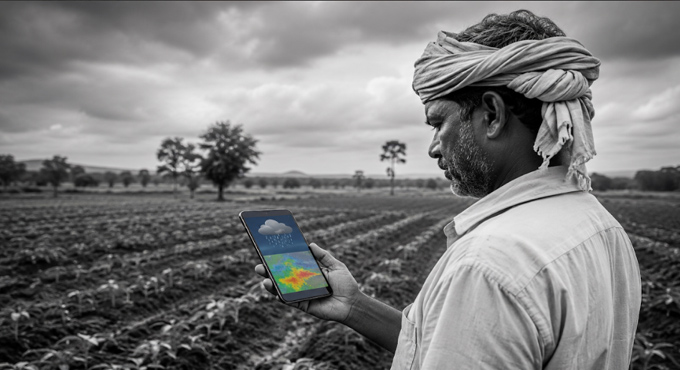
Small farmers in Telangana’s Medak and Mahbubnagar districts used AI-powered weather forecasts to make better farming decisions. The system helped them understand possible weather risks and change their farming practices at the right time. Some farmers changed their spending, while others avoided losses and made better investment decisions.
The result was remarkable. Some farmers were able to save as much as $560 per farmer, or more than ₹50,000. For a small farmer, that is not a small amount. It can make a real difference to the family’s finances and the next farming season.
But the real story is not just about the money saved. It is about what created that saving. A farmer did not need access to a giant AI model or a billion-dollar technology company. A relatively simple AI-powered weather tool gave him useful information at the right time, and that information helped him make a better decision.
It’s Not About Size. It’s About Impact
This is the bigger message from the World Bank report. For developing countries, the value of AI should not be measured only by the size of the model or the amount of computing power behind it. A more important question is how much real value AI can create in the everyday lives of ordinary people.
Developing countries do not necessarily need to spend billions of dollars trying to build the world’s biggest AI models. They can also focus on affordable “Small AI” applications that solve specific local problems and make them available to millions of people.
Imagine an AI system that tells a farmer when weather conditions may become risky. Another that helps a small shop owner predict what customers will buy next week. Another that warns a village about a possible flood. Another that helps governments identify gaps in tax collection or improve welfare programmes.
Each of these may look like a small application. But when millions of people start using them, their combined economic impact can become enormous.
That is why the Telangana example matters. It shows that AI does not always have to be revolutionary in appearance to be revolutionary in impact. Sometimes, giving the right information to the right person at the right moment can be enough to change an important decision.
Why This Matters for India
India has a unique advantage in this new AI race. On one side, the country has a large pool of engineers, technology companies and AI talent. On the other side, it has millions of farmers, small businesses and government services dealing with everyday problems.
That creates a huge opportunity. India can certainly compete in the global race to build powerful AI models. But it can also build thousands of smaller AI systems designed specifically for Indian problems. In many areas, that could have a more direct impact on people’s lives.
The World Bank has warned that developing economies already paid a heavy price for missing the first Industrial Revolution. They cannot afford to miss the AI revolution as well.
But this time, the rules may be different. A country does not necessarily need the biggest AI model in the world to benefit from the AI revolution. It needs the ability to identify real problems and use affordable technology to solve them at scale.
The Telangana farmer story is a powerful example of that idea. It shows that the AI revolution is not happening only inside the giant data centres of Silicon Valley. It is already creating value in the fields of Telangana.
The future of AI may not be decided only by who builds the biggest model. It may also be decided by who can use small, affordable AI tools to improve millions of everyday decisions.
The biggest AI revolution may begin with the smallest decision.