Is Gen Z Rejecting AI Movies? Christopher Nolan Thinks the Audience Has Changed
- Published By: Tech Team
- July 13, 2026 / 11:53 AM IST


By Surya Prakash Josyula
The lights go out inside a theatre.
The screen turns completely dark.
A trailer for a much-awaited film begins. Massive visuals, stunning cinematography and a powerful background score fill the auditorium. Two minutes later, the trailer ends.
The lights come back on.
People walk out.
Nobody is talking about the hero.
Nobody is talking about the director.
Instead, there is only one comment.
“Bro… most of it was made with AI.”
A few years ago, that sentence would have sounded like a compliment.
Today, it sounds like criticism.
That small shift has created a much bigger question for the film industry.
Has technology slowed down, or have audiences changed faster than technology itself?
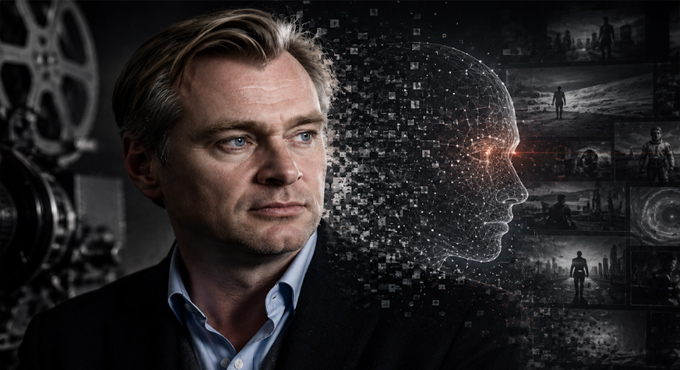
That is the question filmmaker Christopher Nolan is now asking.
Nolan Is Not Surprised by AI. He Is Surprised by the Audience.
Most discussions around AI focus on the same topics. Will it replace jobs? Will it replace filmmakers? Will AI eventually make entire movies?
But Nolan is looking at something different.
According to him, the bigger story is not how fast AI is improving. It is how quickly audiences are learning to recognise AI-generated content.
Speaking about Gen Z, Nolan said he has never seen a generation identify and reject a major technological shift so quickly.
Using his own children as an example, he explained that young people who grew up in the online world can easily recognise artificial-looking content. In his view, they are much faster at spotting what feels fake.
What Is “AI Slop”?
One of the most popular terms on social media today is “AI Slop.”
It is not an official technical term. Instead, it is used to describe low-quality AI-generated images, videos, posters and online content that lack originality and are produced quickly using similar templates.
The criticism, therefore, is not aimed at AI itself. It is aimed at using AI as a shortcut without creativity or effort.
Is Nolan Against AI?
Not at all.
Nolan has made it clear that AI can be useful in several fields. However, he believes it has arrived at a difficult moment for filmmaking.
Over the last few years, the industry has moved heavily towards virtual production and digital effects. At the same time, many people in the industry believe audiences are once again showing greater interest in real locations, practical effects and more authentic storytelling.
Nolan also praised young filmmakers Curry Barker and Kane Parsons for using practical effects in their work, suggesting that audiences are once again looking for a stronger human touch.
Why Do Nolan’s Comments Matter?
These comments would probably not have attracted the same attention if they had come from someone else.
Christopher Nolan is known for embracing advanced IMAX technology while still relying heavily on practical sets, real stunts and in-camera filmmaking whenever possible.
That is why his comments are significant. He is not rejecting technology. Instead, he is talking about its limitations in filmmaking.
Is the Same Trend Visible in Telugu Cinema?
This discussion is not limited to Hollywood.
Even among Telugu audiences, comments such as “This looks like an AI poster” have become increasingly common whenever new posters or promotional material are released. AI-generated thumbnails are recognised quickly, and audiences openly question visuals that appear to rely on technology without enough story or emotion.
That does not mean every AI-generated visual is bad. Many impressive AI creations are being produced.
However, audiences seem to be judging content differently now. Instead of asking, “Was this made using AI?”, they are asking, “Did this actually move me?”
The Real Debate Is About Trust
The question is no longer whether AI should be used.
The bigger question is how it should be used.
AI can become a powerful creative tool for research, pre-visualisation, editing and visual effects. But if audiences begin to see it only as a shortcut, even the most advanced technology may struggle to create genuine emotional impact.
In the End, Audiences Don’t Judge Technology. They Judge Emotion.
Imagine your favourite actor’s next film is announced as being made largely with AI.
Would you still buy a ticket?
Everyone may have a different answer.
But one thing seems clear.
When the lights go out and the story begins, audiences will ask only one question.
“Did this film truly move me?”
If the answer is yes, it may not matter whether AI was used or not.
But if the answer is no, people may walk out of the theatre saying the same thing once again.
“Bro… it was mostly made with AI.”
Perhaps that is the real message Christopher Nolan is trying to convey. The future of cinema may not depend only on how intelligent AI becomes, but also on how audiences continue to respond to it.