
Robots Enter the Factory, Workers Walk Out: Has the First AI Job War Begun?
- Published By: Tech Team
- July 13, 2026 / 12:03 PM IST


By Surya Prakash Josyula
What if your employer no longer needed another human to replace you? What if a robot could do the job instead?
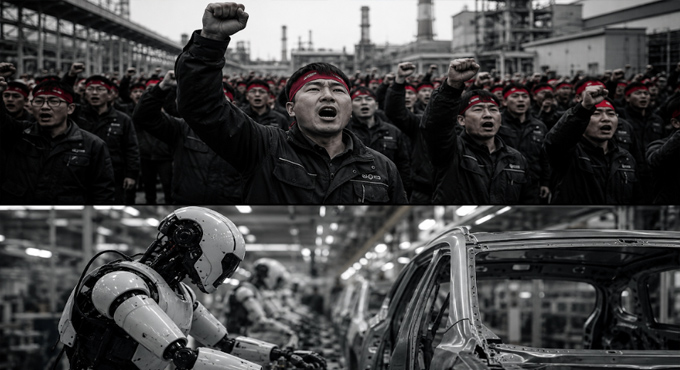
This is not the story of a Hollywood science fiction movie. It is not a distant prediction about the future either. It is a story that is unfolding right now and could soon become relevant across the world. Thousands of workers at Hyundai, one of the world’s largest automobile manufacturers, have gone on strike over fears that humanoid robots and AI-driven automation could eventually threaten their jobs.
Until now, discussions about AI replacing human workers mostly remained limited to social media and expert debates. But for perhaps the first time, thousands of factory workers are demanding written guarantees that their jobs and incomes will be protected before robots become part of the production process. Their message is simple: don’t bring robots into our workplace unless our future is secure.
This Is Not Just South Korea’s Story
It may appear to be a labour dispute happening in South Korea, but the questions it raises are much bigger. If similar automation reaches Hyundai’s plant in Chennai or expands across companies such as Tata Motors, Mahindra, Maruti Suzuki, Kia or Ashok Leyland, the same concerns could emerge in India.
The issue is not limited to automobile manufacturing. If AI-powered automation spreads across banking, IT services, warehouses, hospitals and logistics, millions of workers could eventually face similar questions about job security. That is why this strike is attracting attention far beyond South Korea. It is a story about the future of work itself.
Atlas: The Robot Designed for Factory Work
Automation has existed in factories for decades, but Hyundai is preparing for something different. The company plans to introduce Atlas, a humanoid robot capable of walking, lifting heavy objects and performing complex assembly tasks that are traditionally handled by human workers.
For many employees, the concern is no longer that robots will simply assist humans. The fear is that robots could gradually replace them.
The Bigger Fight Is About Profits
Many people see this as a conflict between workers and robots. However, Hyundai workers are also raising another important question.
Recently, technology companies such as Samsung Electronics and SK Hynix rewarded employees with massive bonuses after benefiting from the AI boom. Hyundai workers argue that if AI helps companies generate higher profits, employees who contribute to that success should also receive a fair share of those gains.
Their demand has therefore become larger than wages alone. It has opened a broader debate about who should benefit from the wealth created by AI—company owners, shareholders or the workers whose jobs are being transformed.
From ATMs to AI
Technology has always raised concerns about employment. Similar fears were expressed when ATMs became common in banks and when self-checkout systems appeared in supermarkets. Every major technological shift has brought the same question: will human jobs survive?
The difference today is the speed and scale of AI-driven automation, which many believe could reshape industries much faster than previous technological changes.
A Strike With Global Consequences
Even a short strike at Hyundai has significant financial consequences. Last year’s partial strike lasted only 16 hours but reportedly reduced production by around 7,000 vehicles and caused losses worth hundreds of billions of won. With workers now staging a three-day strike, the impact on production and global vehicle supply could be much greater.
Conclusion
History has reached an interesting turning point.
Humans once built robots to make work easier. Today, workers are protesting because they fear those same robots could eventually replace them.
The strike at Hyundai may not simply be another labour dispute. It could mark the beginning of a much larger global debate about AI, automation and the future of human employment.
Related News

AU Small Finance Bank’s Wheels Business Crosses ₹50,000 Crore AUM Milestone

BenQ Unveils “MOBIUZ Game Art Museum” Experience at Tokyo Game Show 2026

Dreame Technology Launches Flagship X60 Ultra Complete Robot Vacuum in India

Turtle Wax Marks 80 Years of Global Leadership as CEO Laurie King Visits India to Accelerate Expansion Plans
Hyundai Motor India Opens Bookings for the New Intelligent Utility Vehicle, Hyundai BAYON