

The AI Workforce Reckoning: Who’s Deploying It, Who’s Losing Jobs

- Published By: Tech Team
- April 14, 2026 / 11:46 AM IST


What It Means for India’s 5.8 Million Tech Workers
From India’s IT corridors to Silicon Valley, AI has moved from boardroom experiment to blunt operational tool. In 2026, the layoffs are filed, the sectors are named, and the numbers are in.
Telugu Times Technology Desk | Source: Stanford HAI 2026 AI Index
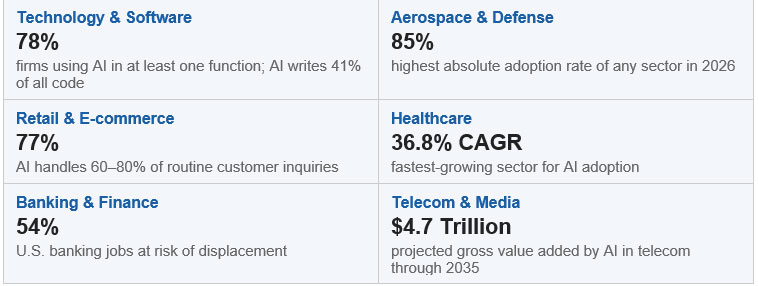
Across every major sector in the United States and India, AI is no longer a future threat — it is a present restructuring force. Worker access to AI tools rose 50% in 2025 alone, and the number of companies with large-scale AI in production is set to double within six months. The shift is no longer gradual.
Where the adoption is happening — and how fast
The jobs picture: USA
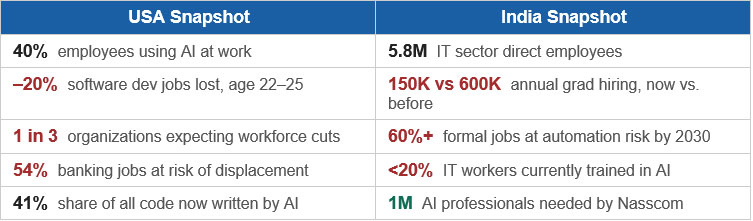
The structural pressure on American tech workers is no longer theoretical. Roughly 43 million U.S. jobs face significant AI exposure within a one-year horizon. In software specifically, a near-20% drop in employment among developers aged 22 to 25 is the clearest sign yet that AI is compressing entry-level demand before it reshapes senior roles.
The jobs picture: India
For India, the stakes are more concentrated. Unlike previous automation waves, AI targets precisely the non-routine, white-collar service work India built its tech economy on — BPO, software testing, back-office processing — sectors that anchor the country’s middle class and account for 7.5% of GDP.
The rupture is already showing in hiring. India’s IT majors once absorbed 600,000 engineering graduates a year. Analysts warn that 20 to 25% of new graduates may remain unemployed, with ripple effects spreading across India’s services-dependent urban economy. At the firm level, TCS has cut over 12,000 positions at middle and senior levels, and in the first quarter of 2026 alone, Indian IT and BPO companies may have filed more U.S. WARN layoff notices than in all of 2025.
“We’ve been asking our teams how we can deliver twice the revenue with half the people.”
— C. Vijayakumar, CEO, HCL Technologies
The escape route — if there is one
The picture is not uniformly bleak. Infosys is embedding AI into its core banking and insurance platforms, opening new roles in AI engineering and data science. India’s Economic Survey 2025–26 notes that early evidence from advanced economies has “begun to temper some of the more extreme predictions.” The caveat is sharp: Nasscom says whether the industry is a net employer or net loser “depends on the actions we take.” With fewer than 20% of IT workers currently trained in AI and one million professionals needed by year-end, the skills gap is the defining challenge of this moment.
For the Telugu-speaking workforce — concentrated in India’s tech hubs and spread across American firms from Seattle to San Jose — the message is clear: retraining is no longer optional, it is mandatory.
Source: Stanford HAI 2026 AI Index Report — hai.stanford.edu/ai-index/2026-ai-index-report
By Shiva Duvvuru, CPA. email: [email protected]
Related News

Major Indian Banks Report Strong Q2 FY27 Financial Results with Record Profits and Asset Quality Improvements

KRAFTON Unveils ‘Battlin’, India’s First Unified Esports Tournament Platform for BGMI

Cotecna Expands Global Life Sciences Footprint with Acquisition of Hyderabad-Based Energon Labs

ITC Hotels Signs 104-Key Welcomhotel in Manesar Gurugram to Expand NCR Presence

Weverse Con Festival India Unveils a Landmark Lineup of Global K-Pop and Indian Artists for its Inaugural Edition