
Stellantis Outlines ‘FaSTLAne 2030’ Strategy in India with ₹4,000 Crore Investment and 12 Jeep and Citroën Models
- Published By: Vishal
- October 16, 2026 / 06:25 PM IST


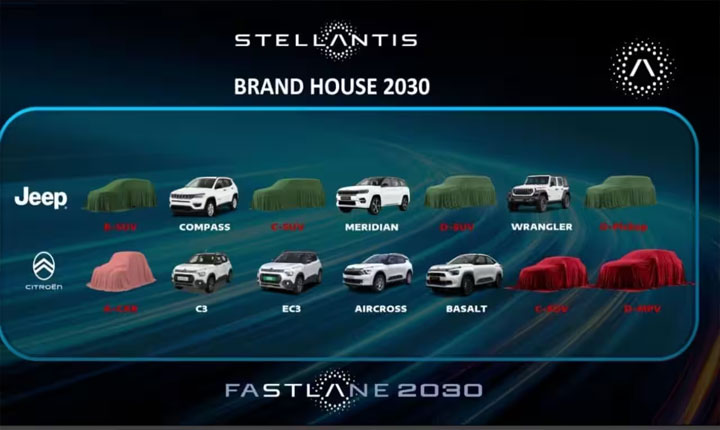
Automotive conglomerate Stellantis has announced its next phase of expansion in India under the FaSTLAne 2030 strategic roadmap. Transitioning from business foundation-building to active market scaling, the group plans to introduce 12 vehicle launches over the next three years across its Jeep and Citroën brands. The upcoming portfolio will consist of seven all-new products and five major model upgrades, covering key vehicle segments including B, C, and D-segment SUVs, an MPV, an A-segment car, and a premium pickup truck. The initial vehicle under this rollout program is scheduled to hit the Indian market in Q2 2027.
Fresh Investment, Financial Growth, and Localisation:
To back its product cadence, Stellantis is committing a fresh capital injection of approximately ₹4,000 crore (€400 million) over the next three years. This brings the group’s cumulative investment footprint in India to nearly ₹15,000 crore by 2030. The strategy builds on solid financial momentum; Stellantis India recorded a 35% sequential business growth in Q2 2026 compared to Q1 2026, while Citroën’s retail sales surged 68% year-on-year in Q2 2026. Furthermore, Stellantis is targeting 90% localisation levels across future Jeep and Citroën models by leveraging its existing manufacturing plants in Ranjangaon (Maharashtra), Thiruvallur (Tamil Nadu), and Hosur (Tamil Nadu).
Multi-Energy Powertrains and Brand Roles:
Addressing India’s evolving clean mobility landscape, Stellantis will adopt a multi-energy powertrain strategy. The future vehicle lineup will encompass:
Internal Combustion Engines (ICE): High-efficiency petrol and diesel configurations.
Hybrid & Plug-In Hybrid (PHEV): Electrified options serving as a middle ground for range confidence.
Battery Electric Vehicles (BEV): Zero-emission electric powertrains derived from global platforms.
Within the dual-brand model, Jeep will focus on strengthening its standing in the premium SUV landscape through enhanced capability and authentic design. Meanwhile, Citroën will target mainstream, high-volume segments with accessible, design-led, and comfort-driven models. Retail presence will also expand into Tier-2, Tier-3, and Tier-4 cities through the Stellantis Brand House retail format.
Global Manufacturing and Sourcing Hub:
India will assume an expanded role as a key manufacturing, engineering, and export hub within Stellantis’ global network. The group currently exports components and complete units to around 50 countries, with its Hosur facility exporting approximately 95% of its engine and gearbox production. Under the FaSTLAne 2030 framework, vehicles developed in India will be exported across international markets as part of the group’s broader Asia-Pacific growth plan.
Leadership Statements:
Tianshu Xin, Chief Operating Officer, Stellantis Asia-Pacific Region, stated: “India has a dual role for Stellantis: it is an important market that we intend to grow in, and an increasingly significant capability base for the region and the wider Group… Under FaSTLAne 2030, our region-led model gives the India team greater ownership of decisions, and the roadmap we are announcing today reflects our long-term conviction in this market.”
Shailesh Hazela, CEO & Managing Director, Stellantis India, added: “Our commitment to India will be measured by what we put on the road. Having built a strong foundation over the years, our focus now shifts to scaling the business. Twelve launches across Jeep and Citroën over the next three years will significantly broaden our market participation and give Indian customers more choice across segments and powertrains.”
Related News

Weverse Con Festival India Unveils a Landmark Lineup of Global K-Pop and Indian Artists for its Inaugural Edition

First Cohort of 25 Rural Women Graduates from ‘FlySakhi’ Agricultural Drone Enterprise Programme at IIT Hyderabad
InvoiceCloud Announces ₹350 Crore Growth Plan for Hyderabad Global Innovation Hub
Ujjivan Small Finance Bank Reports Record Q2 PAT of ₹365 Crore and Board Approves ₹409 Crore Capital Raising

Vi Introduces India’s First Prepaid Family Plan with Nationwide Data Sharing