

India Embraces Climate Resilient Farming
- Published By: Tech Team
- June 4, 2026 / 07:34 PM IST


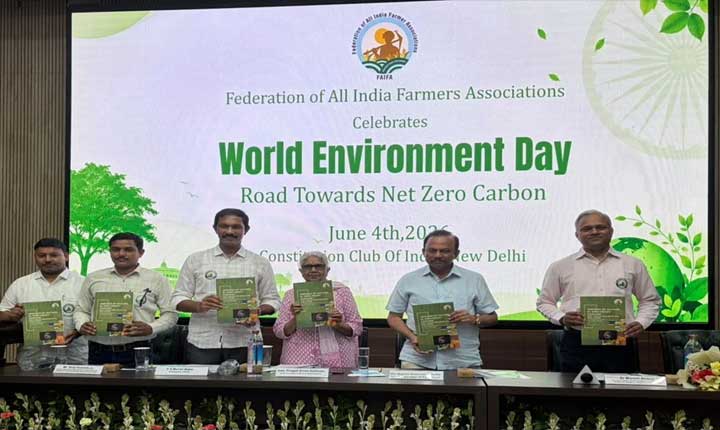
New Delhi: On the eve of World Environment Day, the Federation of All India Farmer Associations (FAIFA) has issued an urgent wake-up call for the nation’s agricultural sector. At a landmark seminar themed “Inspired by Nature: Climate Resilient Farming for a Secure Future,” FAIFA released a comprehensive report warning that climate resilience must immediately become India’s top agricultural priority.
The report, titled “Inspired by Nature: El Niño-Ready Farming for Climate Resilience and Our Future,” was officially unveiled by Shri Magunta Sreenivasulu Reddy, Honorable Member of Parliament from Ongole, Andhra Pradesh. The document serves as a strategic roadmap to protect food security and farmer livelihoods against the looming threats of unpredictable monsoons, extreme weather, and intensifying El Niño conditions.
The Cost of Inaction: Key Statistics from the Report:
331 out of 334 days: The number of days India experienced extreme weather events between January and November 2025.
17 million hectares: The total cropped area damaged by these climate disruptions.
97% of soil samples: Deficient in critical nitrogen levels.
85% of soil samples: Lacking adequate organic carbon, highlighting a severe soil degradation crisis.
Balancing Tradition and High-Tech Innovation:
The report emphasizes that navigating future climate shocks requires a dual approach: a technological transition combined with an ecological restoration. Experts at the seminar highlighted that the path forward lies in merging countries-old traditional agricultural wisdom with cutting-edge digital infrastructure.
1. Ecological Roots:
To heal India’s depleted soils and build natural defenses, the report advocates for a return to nature-inspired practices. This includes promoting crop diversification, expanding natural farming under the NMNF initiative, restoring crucial soil nitrogen levels, and adopting traditional indigenous water management systems to reduce reliance on heavy chemical inputs.
2. Digital Frontier:
By scaling up existing government programs like the Digital Agriculture Mission, AgriStack, and Bharat-VISTAAR, farmers can leverage technology to stay ahead of weather shifts. Key innovations driving this frontier include Artificial Intelligence (AI) for precision irrigation, remote sensing via the Drone Didi initiative, and real-time, weather-based advisory networks.
Empowering Rural Communities and Women Entrepreneurs:
A major highlight of both the report and the seminar was the acknowledgment of the pivotal role women play in rural transformation. The blueprint calls for accelerating resilience by leveraging established networks of female leaders, including:
Krishi Sakhis & Drone Didis: Driving the frontline adoption of natural farming techniques and smart tech.
Self-Help Groups & SHE Marts: Expanding localized economic independence and market access.
Lakhpati Didi Program: Scaling up rural enterprises to ensure small and marginal farmers remain financially secure despite erratic crop yields.
Moving from Reactive to Proactive Planning:
Historically, agricultural planning has relied on reactive responses to droughts or monsoonal deficits. FAIFA argues that with El Niño heavily impacting the critical kharif (monsoon) cropping season, India must pivot toward proactive risk management. This includes expanding protective irrigation networks, broadening the scope of the PMFBY (crop insurance system), and creating regional climate adaptation strategies specifically tailored for high-value agriculture.
Speaking at the event, PS Murali Babu, President of FAIFA, summarized the urgency:
“Climate change is no longer a future challenge but a present reality affecting farmers across the country. The findings of this report clearly demonstrate that resilience must become the organizing principle of future agricultural development.”
The seminar concluded with an awards ceremony honoring climate-resilient farmers, young tech innovators, and sustainable Farmer Producer Organisations (FPOs) who are already leading the charge toward an environmentally responsible, secure, and self-reliant agricultural future.
Related News

BenQ Unveils “MOBIUZ Game Art Museum” Experience at Tokyo Game Show 2026

Dreame Technology Launches Flagship X60 Ultra Complete Robot Vacuum in India

Turtle Wax Marks 80 Years of Global Leadership as CEO Laurie King Visits India to Accelerate Expansion Plans

Hyundai Motor India Opens Bookings for the New Intelligent Utility Vehicle, Hyundai BAYON

Telangana AI Summit 2026 Drives State’s Vision to Become a Global Artificial Intelligence Hub