
Bike Ambulances to Get National Standards: What MoRTH’s Draft Rules Propose
- Published By: Phanindra
- August 8, 2026 / 07:54 AM IST


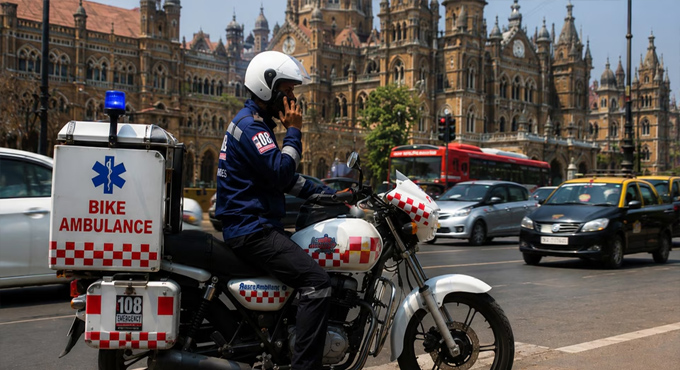
To provide rapid emergency medical care in congested city traffic, narrow lanes, and remote areas inaccessible to traditional ambulances, the Central Government has introduced key proposals to regulate two-wheeler ambulance services. While various states have already been utilizing these bike ambulances, there has been a lack of unified national regulations governing them.
To address this gap, the Ministry of Road Transport and Highways (MoRTH) has released a draft notification amending the Central Motor Vehicles Rules (CMVR), 1989. The proposal introduces specific technical standards designated as ‘AIS-209 (Part 1):2026’ and will officially recognize two-wheeler ambulances as L2 category transport vehicles. These new, standardized regulations are set to be implemented nationwide for all bike ambulances manufactured on or after October 1 of next year.
Mandatory Safety Features and Fitness Certification
Under the newly proposed rules, bike ambulances will be required to meet strict safety and operational standards. It will be mandatory for these vehicles to feature a safe patient transit system, high braking efficiency, proper balancing mechanisms, emergency top lights, fail-proof stretcher locking systems, and onboard fire extinguishers.
Because these bike ambulances will be officially classified as ‘transport vehicles’, they will be required to renew their fitness certificates periodically every two years. Transport department officials will mandate rigorous physical inspections before granting these fitness renewals.
The government anticipates that establishing these national standards will serve as a major milestone in improving emergency medical response times and ensuring critically ill patients reach hospitals safely. The ministry is currently seeking public feedback and suggestions on this draft proposal for a period of 30 days.
Related News

BenQ Unveils “MOBIUZ Game Art Museum” Experience at Tokyo Game Show 2026

Dreame Technology Launches Flagship X60 Ultra Complete Robot Vacuum in India
Turtle Wax Marks 80 Years of Global Leadership as CEO Laurie King Visits India to Accelerate Expansion Plans

Hyundai Motor India Opens Bookings for the New Intelligent Utility Vehicle, Hyundai BAYON
Telangana AI Summit 2026 Drives State’s Vision to Become a Global Artificial Intelligence Hub