
AI Has Learned the Language of Farmland… And It’s Becoming a New Ally for Farmers
- Published By: Tech Team
- July 6, 2026 / 01:55 PM IST


By Surya Prakash Josyula
Imagine this.
A farmer walks into a bank with the same old file he has carried many times before. Inside are his land records, Aadhaar card, and every document the bank usually asks for. He hopes that this time his agricultural loan will finally be approved.
Instead of opening the file, the bank manager looks at his computer screen and asks, “You planted paddy again this season, didn’t you?”
The farmer nods in surprise.
Then comes another question.
“The northern side of your field has less water this year, right?”
The farmer is stunned. He never mentioned it. No bank officer has visited his farm. Yet the manager already seems to know what is happening on his land.
“Sir… have you been to my village?” the farmer asks.
The manager smiles.
“No. Our satellite has already seen your farm.”
This scene is fictional—for now. But it may not remain fiction for much longer. Across India, Artificial Intelligence (AI) and satellite technology are quietly changing the way agricultural loans are processed, making it possible for banks to understand farmland faster than ever before.
For decades, getting a farm loan meant paperwork, physical verification, and long waiting periods. Farmers had to submit documents, bank officials had to visit their fields, reports had to be prepared, and multiple rounds of verification followed before a decision could be made. The entire process often took between 15 and 30 days.
For a farmer, that delay can be costly.
By the time the loan arrives, the sowing season may already be over. Good-quality seeds may no longer be available. Fertilizer prices may have increased. In agriculture, money is important—but getting that money at the right time is even more important.
This is where AI is beginning to make a difference.
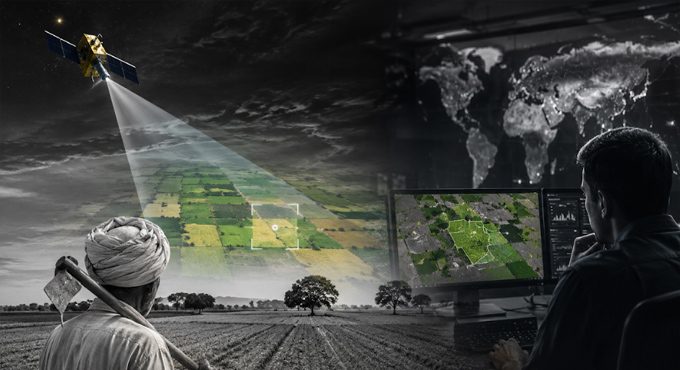
Hundreds of kilometres above the Earth, satellites continuously capture images of farmland. They record what crops are being grown, how much land is under cultivation, whether irrigation is available, how healthy the crops are, how rainfall has affected the fields, and even how the land has performed over previous seasons.
But satellites only collect images.
They do not understand them.
That job belongs to AI.
Artificial Intelligence analyses those satellite images, identifies crops, studies crop health, estimates acreage, examines rainfall patterns, groundwater availability, temperature, and historical farming data. It then converts all of this into a digital farm report that gives banks a much clearer picture of what is actually happening on the ground.
In the past, farmers had to explain their fields.
Today, in many cases, their fields are beginning to speak for themselves.
This doesn’t replace the farmer’s voice. Instead, it adds something that did not exist before—trusted, data-driven evidence.
As a result, agricultural lending is becoming much faster. What once took 15 to 30 days can now, in some cases, be completed in less than an hour, allowing certain loans to be approved and disbursed on the very same day.
AI is not giving farmers money.
It is helping money reach farmers at the time they need it most.
That difference can decide an entire cropping season.
This transformation is no longer just an experiment.
More than 1.5 million farm plots and nearly 195,000 villages across India have already been analysed using this approach. One of the companies driving this change is Bengaluru-based SatSure, founded by former ISRO scientists. By combining satellite imagery with AI, the company provides digital farm intelligence that banks, financial institutions, and government agencies can use while making lending decisions.
The impact of this technology extends far beyond agricultural loans.
The same satellite data could soon play an important role in crop insurance, crop-loss assessment, compensation, climate-risk monitoring, and early warning systems for extreme weather. In other words, AI is not simply speeding up farm loans—it is gradually becoming part of a smarter agricultural ecosystem.
Of course, important questions remain.
What happens if cloud cover blocks satellite images? Can very small farms be analysed accurately? What if the data is incorrect? Will farmers be able to challenge an inaccurate assessment? Can technology ever replace human verification completely?
Experts believe the answer is no.
AI should not replace human judgment. Instead, it should become another reliable source of information that helps banks make faster and better decisions.
In the end, the biggest change is not that AI has entered agriculture.
The biggest change is that farmland is finally becoming visible in ways it never was before.
The fields were always telling their story.
For generations, the world simply couldn’t hear it.
Now…
AI is finally learning their language.
Related News

BenQ Unveils “MOBIUZ Game Art Museum” Experience at Tokyo Game Show 2026

Dreame Technology Launches Flagship X60 Ultra Complete Robot Vacuum in India

Turtle Wax Marks 80 Years of Global Leadership as CEO Laurie King Visits India to Accelerate Expansion Plans

Hyundai Motor India Opens Bookings for the New Intelligent Utility Vehicle, Hyundai BAYON
Telangana AI Summit 2026 Drives State’s Vision to Become a Global Artificial Intelligence Hub