
Why ‘Perfect’ is the New Fake: The One Mistake That Exposes AI Faces
- Published By: Tech Team
- July 6, 2026 / 09:02 AM IST


— Surya Prakash Josyula
A new Friend Request lands on Facebook. A beautiful profile pops up on Instagram. An attractive DP catches your eye on WhatsApp.
In a split second, your brain makes a definitive judgment: “The person on the other side is real.”
We click, we reply, and we proceed. We make these decisions in fractions of a second.
But here is an unbelievable truth: that choice wasn’t entirely yours. It was manipulated by Artificial Intelligence.
How? AI has already decoded how our brains think and make judgments. Today, AI isn’t just targeting our eyes; it is targeting our psychological trust. This is the ultimate reality of our digital era. However, the real takeaway we need to understand and protect ourselves from is this:
It is not about how smart AI has become. It is about how easily our brains are wired to believe it.
A face… Two eyes… A warm smile… A dash of beauty… That’s all it takes.
Our brain instantly looks at these elements and declares, “Yes, that’s a human.” AI is successfully winning this digital game by exploiting this exact psychological vulnerability. Here is the subtle logic behind it:
Do you trust your eyes? Most people will immediately say, “Yes.”
But what about your brain? You pause for a second…
Because what your eyes see is one thing, but what your brain is led to believe is another. AI wins right in the middle of this confusion. It knows exactly how that feeling of “this is a real human” is generated inside our minds. As a result, it is no longer just designing human faces; it is designing human trust.
Once upon a time, spotting an AI image was easy. A distorted ear, an extra finger, weirdly shaped eyes, or an unnatural row of teeth. We would spot those flaws and confidently say, “This is AI.” Back then, AI tried hard to deceive us, but its own technical glitches gave it away. Today, those glaring glitches have practically vanished.
Now, it’s not the photos being hacked—it’s our perception. This isn’t a story about photography; it’s a story about the human brain. Our brain has an evolutionary weak spot: if something looks highly symmetrical, exceptionally beautiful, and somewhat familiar, it automatically accepts it as real. It is a natural survival instinct formed over millions of years of evolution.
AI is now weaponizing this exact human trait. This is precisely what researchers at the Australian National University studied and proved.
The breakthrough in their study happened when they stopped looking for technical errors in AI and instead asked a fundamental question: Why do AI faces look so incredibly real to us?
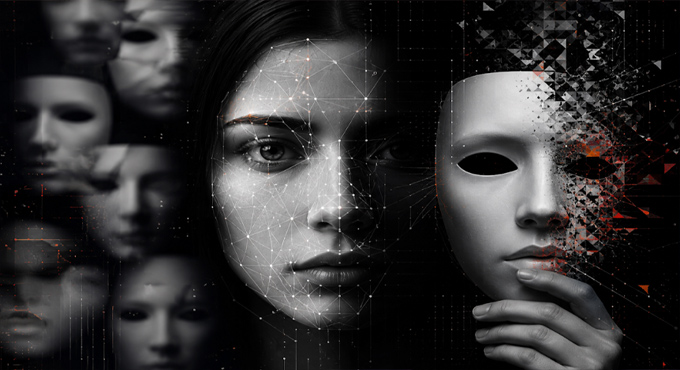
AI does not simply copy a specific person’s face. It scans millions of photos, extracts the most common structural patterns, and creates a mathematical average of all those traits to generate a completely new face. That is why the face belongs to absolutely no one, yet feels vaguely familiar to everyone. That is where the digital magic lies.
But just like every criminal—no matter how meticulously they plan—leaves behind a tiny clue, AI does too.
Strangely enough, its biggest flaw is not that it is too clever. Its ultimate flaw is that it is too perfect.
Researchers identified six specific, persistent global traits that continuously appear in AI-generated faces. Let’s look at them through a simple analogy.
The Topper and the Currency Note Analogy
The Exam Topper: Students who score a perfect 100 out of 100 in every single exam are incredibly rare. Similarly, small structural asymmetries are completely natural in real human faces. But AI builds every single face like a perfect “100/100 Topper.”
The Crisp Currency Note: If a currency note looks absolutely flawless, hyper-glossy, and entirely pristine, the chances of it being a counterfeit are high. The same logic applies to online faces today.
The 6 Signs to Spot an AI Face
The next time you come across a profile on social media, pause and look for these six traits:
Extreme Symmetry: The left and right sides of the face match so perfectly that it looks like a mirrored reflection.
Hyper-Attractive: The faces possess an exaggerated, flawless beauty and an artificial digital glow.
Perfect Proportions: The eyes, nose, and mouth are placed in mathematically flawless alignments.
Low Expressions: There is a distinct lack of life in the eyes, and genuine, warm human expressions are missing.
Zero Distinctiveness: The skin is like a clone—free of any unique moles, natural blemishes, or characteristic lines.
Instantly Forgettable: Despite being strikingly beautiful, these faces do not register deeply in our memory. You forget what they looked like moments after scrolling past.
The New Digital Threat: ‘The Man Who Never Existed’
Massive scams are operating right behind these synthetic AI faces, hitting closer to our daily lives than we think:
Romance Scams (Honey Traps): Fraudsters use attractive AI photos to create fake online girlfriends or matrimonial profiles, tricking unsuspecting individuals out of millions of rupees.
Job Scams: Fake LinkedIn profiles featuring corporate-looking AI headshots pose as big-company HR managers, cheating job seekers.
Investment Scams: Fraudsters set up profiles of fake CEOs and wealthy entrepreneurs to lure people into fraudulent investment schemes.
Fake Influencers: Instagram accounts with hundreds of thousands of followers posting content, when in reality, the person on screen does not even exist.
Interesting Facts:
Popular platforms like Zoom and Tinder can no longer rely on a simple profile photo to verify an identity. This is why they are aggressively rolling out mandatory ‘Face Verifications’ and biometric checks (like retinal scans) to prove that a living, breathing human exists behind the screen.
Because of this, public perception is shifting. When people see a picture or a video online today, they no longer just ask, “Does this look good?” Instead, they pause and wonder, “Does this person actually exist?”
Conclusion
AI is evolving with every passing second. Tomorrow, the clues we rely on today might completely disappear. But one fundamental truth will never change: what makes us humans unique is not our flawless beauty.
It is our beautiful imperfections. A tiny mole, a slightly asymmetrical smile, or one eyebrow sitting just a fraction higher than the other—these are the unique human signatures that make us memorable. AI is still desperately trying to replicate these human irregularities.
Until then, the single biggest mistake AI makes is the very thing that exposes it.
Flawless perfection is never the work of nature. It is the work of an algorithm.
And as long as we choose to trust nature, no algorithm can completely fool us.
Related News

GIRI Opens 39th Showroom and Cultural Hub on MG Road, Puducherry

Citizens Specialty Hospital in Nallagandala Marks World Heart Day with Community Walkathon

JioStar Unveils ‘Har Ghar Mein Jashn’ Festive Playbook to Help Brands Capture Surge in Consumer Spending

Rapido Expands Food Delivery App Ownly to Hyderabad with a Unique Captain Biryani Celebration

Sennheiser Launches MOMENTUM 5 Wireless and MOMENTUM True Wireless 5 in India