
AI Could Make Large Firms Net Job Losers, Says Nilekani; Backs Applied AI
- Published By: Phanindra
- August 10, 2026 / 11:40 AM IST


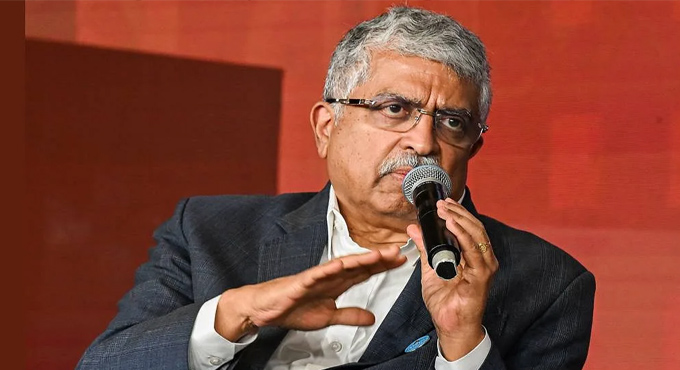
Infosys co-founder Nandan Nilekani has made significant predictions regarding the future of employment in India, stating that millions of small businesses, rather than large corporate entities, will be the primary engines of job creation in the coming years.
Speaking at an event organized by the National Council of Applied Economic Research (NCAER), Nilekani explained that roles in large organizations are often highly specialized and restricted to specific tasks. This structure makes them easier to automate using Artificial Intelligence (AI). As a result, such companies could eventually become “net job losers.” In contrast, employees in small businesses typically juggle multiple responsibilities, minimizing the impact of AI-driven automation and positioning these enterprises as the focal point for future employment growth. To facilitate this economic shift, Nilekani emphasized the need to empower small businesses through targeted measures:
– Simplifying regulatory compliance.
– Enhancing access to credit through initiatives like the Account Aggregator framework.
– Expanding market reach across the country utilizing platforms like the Open Network for Digital Commerce (ONDC).
– Making AI-driven business tools more accessible to smaller firms.
India as the ‘AI Use Case Capital’
Addressing the country’s AI strategy, Nilekani suggested that instead of fiercely competing in the capital-intensive manufacturing of chips, data centers, or Large Language Models (LLMs), India should focus on “applied AI” to solve real-world problems in sectors like education, agriculture, and healthcare. By making AI accessible through Indian languages and voice-based interfaces, vital knowledge and services can easily reach billions of people. This approach, he noted, has the potential to transform India into the global ‘AI use case capital’.
Furthermore, as the fundamental nature of jobs undergoes a rapid transformation, Nilekani advocated for a portable social security system. This setup would allow employees to carry their pensions, insurance, healthcare benefits, and educational credentials seamlessly from one job to the next. He concluded that to fully harness the demographic dividend of its youth, India must simultaneously prioritize quality education, skill development, entrepreneurial opportunities, and robust job creation.
Related News

Homegrown Tech Brand Mivi Steps Into Smartphone Market With Mivi One 5G Series Starting at ₹11,999 on Flipkart
Star Health Expands Healthcare Partnerships in Rajahmundry to Improve Cashless Access

Natural Diamond Council Rebrands as ‘The Diamond Collective’ with New Global Strategy

SENNES Takes Lab-Grown Diamonds to Milan Fashion Week with Dhruv Kapoor

AU Small Finance Bank’s Wheels Business Crosses ₹50,000 Crore AUM Milestone