
D. Sridhar Babu calls GrowthX 2026 a platform to shape “What Comes Next” in Industry–Technology Integration
- Published By: Tech Team
- February 24, 2026 / 03:37 PM IST


Dr Nageshwar Reddy called to reform laws to enable the ethical use of human organs for Medical Research, just like other countries allow
Space Travel at a cost of air ticket travel is not too far away: Pawan Kumar Chandana, Co-founder, Skyroot Aerospace
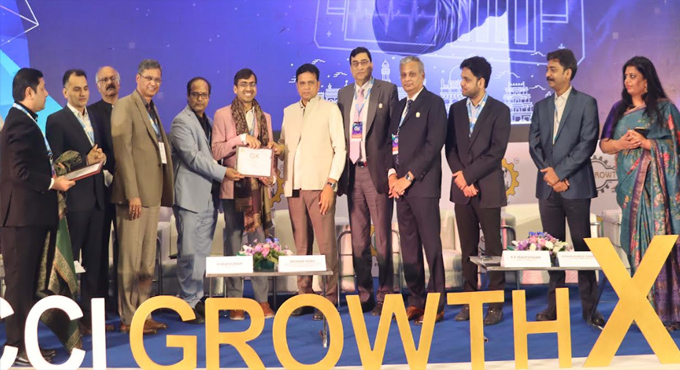
Hyderabad, February 24, 2026: Addressing the GrowthX 2026 summit at JRC Convention Centre, Jubilee Hills on Tuesday, Minister for Information Technology, Electronics & Communications, Industries & Commerce, and Legislative Affairs, Government of Telangana, Shri D. Sridhar Babu, described the platform as a timely and strategic conversation about “what comes next” for Hyderabad, Telangana, and India in an increasingly technology-driven and competitive global landscape.
Mr D. Sridhar Babu, the Minister for IT, was the Chief Guest at the second edition of a full-day GrowthX.
N. Ramchander Rao, BJP State President, D. Nageshwar Reddy, Chairman of AIG Hospitals and a globally renowned gastroenterologist and Pavan Kumar Chandana, Co-founder and CEO of Skyroot Aerospace too graced and addressed the gathering.
Hosted by the Federation of Telangana Chambers of Commerce and Industry (FTCCI), GrowthX 2026 is a national platform aimed at accelerating structured collaboration between industry, technology leaders, academia, venture funds, and policymakers. The summit features keynote addresses, policy-focused discussions, startup showcases, and the unveiling of an Innovation Challenge Portal and a Thought Leadership Report to support digital transformation across sectors.
The event brings together over 750 industry leaders, more than 40 startups, venture funds, and academic institutions, reinforcing Telangana’s vision of becoming a global industry leader–technology integration.
Reflecting on the summit’s theme, Minister D. Sridhar Banu remarked that the “X” in GrowthX represents the unknown that nations, industries, and ecosystems must collectively discover. In mathematics, X is what we seek to solve; in technology, it is what we experiment with; and in growth, it signifies the next phase of transformation. He emphasised that GrowthX is not merely an event, but a dialogue on the future of growth in a world where economies are interconnected, and innovation defines competitiveness.
The Minister highlighted the changing global economic environment, noting that geopolitics is increasingly shaping economic strategy, supply chains are being redesigned for resilience, and technology is accelerating decision-making cycles. Artificial Intelligence, shrinking innovation cycles, and strategic policy choices are redefining how businesses operate and compete.
He observed that in such an environment, ecosystem strength has become a decisive competitive advantage. Cities and regions that combine talent, infrastructure, and policy clarity will lead the next decade of growth. India, he noted, stands at a pivotal moment in this transition, with Telangana playing a proactive role in shaping the future.
Speaking about the state’s long-term vision, the Minister stated that Telangana, currently a $200 billion economy, is not focused on incremental growth but on a transformative trajectory. The state has set ambitious goals of becoming a $1 trillion economy by 2034 and a $3 trillion economy by 2047.
He outlined Telangana’s strategic CURE–PURE–RARE framework as the foundation of the state’s growth architecture. Under CURE, cities—particularly Hyderabad—serve as engines of urban-driven innovation and global services, strengthening Telangana’s position in technology, research, and knowledge-led industries. Through PURE, the state is accelerating industrial corridor–powered manufacturing expansion, creating robust infrastructure and enabling large-scale industrial growth. Meanwhile, RARE focuses on enhancing rural productivity and driving inclusive growth models, ensuring that development is balanced, sustainable, and benefits communities across the state.
This structured ecosystem design, he said, ensures that Telangana does not merely respond to global shifts but leads them.
The Minister identified key shifts shaping the next phase of growth: AI infrastructure emerging as a core productivity layer. Global Capability Centres (GCCs) are moving from execution roles to innovation ownership, with Hyderabad as a major hub. Industry 5.0 integrates manufacturing, data, and human capability. Regional competition is increasingly defined by ecosystem strength and collaboration. Business decisions are shifting from cost-based location choices to innovation-driven scaling environments. Government policy focusing on speed, clarity, and friction reduction to enable experimentation and growth.
He emphasised that Telangana’s policy direction is aligned with these structural shifts, positioning the state as a preferred destination for innovation-led investment.
Concluding his address, the Minister underlined three defining trends for the coming decade: ecosystems over individual companies, talent quality over talent volume, and collaboration over competition. He invited industry leaders, startups, academia, and policymakers to partner with the Government of Telangana in shaping the next phase of innovation-led growth.
“Growth will be built together — through partnerships, shared ideas, and connected ecosystems. What begins as conversation today often becomes strategy tomorrow,” he said.
N Ramchander Rao, BJP State President, who was the guest of honour, spoke about how technology is changing the way we live and work. Another big wave technology that would change our lives will be AI, which he said must be used responsibly.
FTCCI President R. Ravi Kumar noted that while the industry appreciates the government’s efforts toward improving ease of doing business, the cost of doing business continues to rise and needs attention. He assured that FTCCI would extend its full support to all initiatives undertaken by the Government of Telangana to strengthen industry growth and competitiveness.
Pavan of Skyroot Aerospace said Space Travel at a cost of air ticket travel is not too far away. We are just ten more years away. We may travel into space at a cost of executive class air ticket fare. Indian tourists travelling into space is not far away and will become a reality in the next 10 years. Telugu states’ contribution to Indian space technology is immense, he added
Dr Nageshwar Reddy highlighted the many innovations undertaken at AIG Hospitals and pointed out that Indian hospitals continue to face limitations in conducting foundational research. Referring to the Nag Stent he developed over two decades ago, he noted that it was never patented, as he believes patenting often drives up costs and limits accessibility for patients.
Speaking on the broader research ecosystem, Dr Reddy observed that current regulations in India do not permit the use of human organs for research purposes, allowing them only for transplantation. He remarked that several other countries have more flexible frameworks that enable organ-based research under regulated conditions. He urged the government to review the existing legal provisions and consider reforms that would responsibly expand research opportunities while maintaining ethical standards.
A journal called NeoVantageX was launched on the occasion. NeoVantageX is an initiative of WDC, a journal that aims to bridge public policy, deep technology, sustainable finance, and global trade ecosystems—offering research-driven analysis, strategic foresight, and actionable frameworks for governments, multilateral institutions, and corporations.
The day-long summit saw over 100 exhibitors exhibiting products and about 1000 delegates attending the summit.
Ravi Kumar, KK Maheshwari, Srinivas Garimella, Sr Leadership of FTCCI, Bala Prasad Peddigari, Chairman of ICT of FTCCI, and Mr Pankaj Diwan, Convenor of GrowthX, graced the summit.
For Media Queries: Solus Media, D. Ramchandram, Mobile: 9848042020
—
Related News
HCL Group’s 50th Anniversary Celebrations Continue in Hyderabad with Devi Sri Prasad Concert
Shriram Group awards scholarships to class 10 toppers from govt school across Telangana constituencies
KLH Aziznagar Brings Global Experts Together to Explore AI and Industrial IoT Security
AI Is Disrupting the Old Job Model; Entrepreneurial Mindset Is the Future”: Dr. J. A. Chowdary
KLH Students Win First Prize at Global Codeverse 2026