

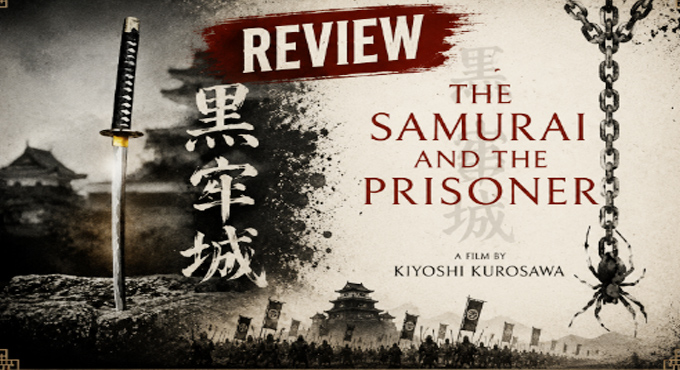
The Samurai and the Prisoner Review: A Warlord, a Prisoner and a String of Unexplained Deaths
- Published By: Tech Team
- September 1, 2026 / 03:30 PM IST


— Surya Prakash Josyula
Rating: 3/5
Not every film set against the backdrop of war has to make the war itself the central character. Sometimes, the real battle does not take place outside the walls of a fortress. It happens inside those walls. Who is a friend? Who is an enemy? Is a death an accident or a murder? How far can fear push people?
The Samurai and the Prisoner opens the doors to a castle from the samurai era and explores these questions through a story filled with mystery, suspicion and fear. The film has also been praised as a masterpiece by several filmmakers, including Martin Scorsese. So, what makes this film stand out?
The Story
The story is set in Japan in 1578, during a period when different regional rulers were constantly fighting for power. Sixteenth-century Japan was not a country ruled completely by one king in the way we understand modern nations today. Different regions were controlled by powerful samurai lords known as Daimyō.
One of the most powerful among them was Oda Nobunaga, a major samurai warlord who had expanded his influence through military strength and brought several regional rulers to his side.
Among the regional Daimyō who were under Nobunaga’s influence or loyal to him was Araki Murashige. Murashige had once fought for Nobunaga and served him loyally. But in 1578, he suddenly rebelled against his powerful leader.
Standing against someone like Nobunaga was almost equal to signing one’s own death warrant. Still, Murashige refuses to back down. He decides to stay inside his castle and resist.
Nobunaga’s army soon surrounds the fortress.
As the conflict outside the castle grows more intense, Kanbei Kuroda arrives on Nobunaga’s behalf. Kanbei is not an ordinary messenger. He is a highly intelligent strategist, and his mission is to convince Murashige to surrender.
Murashige, however, refuses.
He does not allow Kanbei to return either. Instead, he imprisons him in a dark cell inside the castle.
Until this point, the film appears to be a straightforward war drama.
Then comes the real twist.
The people inside the castle know exactly who their enemy is outside. But things do not go as expected. Just a few days after the siege begins, a frightening problem emerges inside the castle itself.
The young son of a prominent warlord dies under mysterious circumstances. Since the boy’s father had recently joined Nobunaga’s side, many believe the death is some form of divine punishment.
But the way the child dies raises serious questions.
He appears to have been struck by an arrow through a narrow opening. It seems almost impossible for an ordinary person to have carried out such an attack.
And the deaths do not stop there.
As the days pass, more strange incidents take place inside the castle. A warrior and a religious figure later die under suspicious circumstances. Are these two separate murders? Or are they part of the same conspiracy?
The mystery deepens further when a warrior is struck by lightning in front of everyone inside the castle.
Was it really a natural accident?
Or was this also a carefully planned murder?
With every new death, fear spreads through the castle. Some people begin to believe that the place has been cursed by God. Others suspect that someone inside the fortress is manipulating everyone.
Murashige decides that the mystery must be solved. But he soon realizes that none of his own men has the ability to crack the case.
That is when he remembers Kanbei.
Kanbei is his enemy. He is also his prisoner. But he is an exceptionally intelligent man.
Murashige is eventually forced to seek Kanbei’s help. The owner of the castle now finds himself depending on the intelligence of the enemy he has locked away.
Kanbei begins investigating the cases one by one.
However, he is not simply looking for an answer to the question, “Who is the killer?” He also examines the politics, personal rivalries, fears of war and religious beliefs behind every death.
Outside the castle, Nobunaga’s army is ready to attack at any moment. Inside, the series of mysterious deaths is destroying the trust of everyone trapped within its walls.
Can Murashige really save his castle? Is Kanbei genuinely helping him? Or is he using his position as a prisoner to play another game of his own?
And most importantly, who is behind these mysterious deaths?
To find the answers, you have to watch The Samurai and the Prisoner.
Story Analysis
The Samurai and the Prisoner has a special connection with Japanese audiences. The film is based on an award-winning 2021 novel by renowned Japanese writer Honobu Yonezawa. For many people who grew up in Japan, the historical background and characters behind this story are not entirely unfamiliar.
For viewers outside Japan, however, understanding the historical setting becomes important before fully connecting with the story.
At the same time, watching The Samurai and the Prisoner simply as a murder mystery means seeing only half the film.
The movie does not follow the familiar commercial screenplay structure. Instead of building the entire story around one central mystery, it divides the narrative into several incidents and secrets. Each new event initially appears to be a separate mystery, but as the story progresses, the connections between them slowly begin to emerge.
One of the strongest elements of the screenplay is the relationship between Murashige and Kanbei.
One man has power.
The other is a prisoner.
But as circumstances change, the equation between them also changes. The person in control is not always the one who has the answers. Neither man completely trusts the other, and this constant tension creates an interesting mind game.
The screenplay follows its own rhythm rather than rushing from one revelation to another.
Kiyoshi Kurosawa’s Direction
Director Kiyoshi Kurosawa’s biggest strength is his ability to create tension without unnecessary drama or noise. He uses small camera movements, the physical distance between characters and long moments of silence to build an atmosphere of unease.
However, the film moves at a slow pace.
For viewers expecting a fast-paced thriller, this can become a test of patience. The film also relies heavily on dialogue, so it requires some attention and patience from the audience.
What Works
Visually, the film is striking.
But there is also a sense of confinement within that beauty. At first, the castle appears to be a place of safety. As the story progresses, the same place slowly begins to feel like a prison.
This transformation is one of the strongest achievements of the film’s cinematography and production design.
The background score also adds to the mystery and strengthens the atmosphere of suspense.
Final Thought
Do not expect large-scale sword fights simply because this is a samurai film.
The Samurai and the Prisoner is less interested in physical battles and more focused on psychological warfare.
It is a slow-burning mystery set during a time of war, where the enemy outside the castle may not be as dangerous as the secrets hidden within it.
Where to Watch
The film can be watched on online streaming platforms. It does not have an official release in India.
Related News

Anbe Diana Movie Review: A Good Idea Lost Between Love and Laughs
The Whisper Man Movie Review: Robert De Niro’s Crime Thriller Delivers Familiar Yet Engaging Suspense

‘Toxic: A Fairy Tale for Grown-Ups’ – A One-Man Show by Yash

‘A Child of My Own’ Review: What Happens When the Desire to Become a Mother Goes Too Far?

‘Don’t Say Good Luck’ Review: A Tearful Story About A Mother-Daughter Bond