

Satyadev’s ‘Rao Bahadur’ Review
- Published By: Tech Team
- July 3, 2026 / 07:20 PM IST


— Surya Prakash Josyula
Rating: 2. 5/5
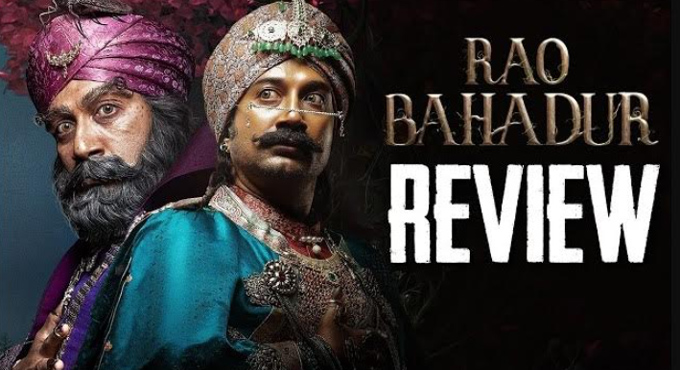
This is the story of Ramappa Rao Bahadur (Satyadev), a leftover zamindar from the 1990-91 era. He drinks a full bottle every day before going to bed and suffers from a psychological-like issue. That issue is suspicion.
As our elders wisely said that suspicion is a monster, that monster nestles in his mind like Putana, constantly sucking out his brains. Yet, it doesn’t seem to pose a problem for him. Because…
Ramappa, who is aging, has plenty of money, property, and status. He owns a massive bungalow filled with servants. He has a liver complaint in his body and an assurance from doctors that he will live for only a few more months.
To top it all off, he has the suspicion manufactured by his idle mind for company. What more does he need? He passes his time drinking and rambling whenever he feels like it.
Alright… what exactly is this suspicion that is drilling into his brain? It is: “My elder son is fair… why was the younger one born dark?” This suspicion is neither going to end nor be resolved, but it grows day by day.
Everyone else in the house has moved on with time, but Ramappa sits around polishing his suspicion every single day. Not only that, but he also discusses this matter with his friend, Doctor Achari (Vikas Muppala), whenever he finds time.
Consequently, Dr. Achari believes that through the upcoming, brand-new ‘DNA Testing’ technology, curtains can finally be drawn on the suspicion that has been haunting Ramappa for years. However, there are many hurdles in the way.
Did they cross them? What happened in the end? Did the DNA test reveal the facts and give peace of mind to Ramappa? Did Ramappa become a normal human being again? This forms the rest of the story.
Analysis
Those who watched the trailer might think this is a Psychological Mystery. Even the first 30 minutes of the film feel the same way. Ramappa has some unknown mental illness. The doctors cannot understand it (and of course, neither can we). An old royal palace, a deceased son, strange dreams, visions of ancestors, a DNA test—seeing all this,
we wait expecting “some shocking mystery at the end.” Of course, there is a twist just as expected. However, what director Venkatesh Maha wanted to convey is not about the mystery or the twist. It is that “lineage is the weight of the thoughts of the dead borne by the living.”
How does the concept of “vamsam” (lineage) take birth in a man’s mind? How does it grow? How does it ultimately consume him? That is the movie. In fact, the film drops an excellent hook in the first 15 minutes itself. “What actually happened to this man?” This is a very powerful Dramatic Question.
But the movie does not answer this question for almost two and a half hours. To keep the audience seated for that long, a new detail, a new conflict, or a new revelation needs to come every 10–15 minutes. None of that happens. As a result, rather than a feeling of the story moving forward, it feels like it is spinning in the exact same spot.
As a writer, Venkatesh Maha has a lot of clarity on what he wants to say. Pride in lineage, obsession with blood relations, patriarchal thoughts, suspicions born out of skin color, and hope riding on DNA—all of these are good ideas.
However, the viewer is not concerned with all this; they want a story and would consider these themes a bonus if delivered alongside it. In such a scenario, the theme should emerge from the story. But here, the story stops and the theme starts talking. Also, the symbolism in this film felt a bit too repetitive.
The setup in the first half moved very slowly. So much so that one wonders when the interval will arrive, or if the interval has already passed without our knowledge. However, the director overcomes this issue in the second half. The actual core of the story is revealed. We understand the thought in Satyadev’s mind and begin to follow it. Also, the mystery begins to unravel layer by layer, providing some relief.
Unlike what many might assume, this is not a Psychological Drama… it is a Social Satire.
Performances
This movie belongs entirely to Satyadev. The film runs with him left, right, top, and bottom. And he carries it through. The other actors faded before his performance at times; at other times, they seemed to relax in the frame, thinking he is performing anyway, so why bother.
Technically, the film is quite sound. They recreated the atmosphere of that era quite well. The background score also pushed the mood of the film forward. As usual, the editing is weak. Venkatesh Maha bravely chose a new point and made an attempt to tell it freshly. Whether it is liked or not is a different matter.
Final Thought
This is a movie that tries harder to make us think rather than to entertain us. At the same time, it is a movie that forgets that if there is too much thinking involved, the number of people falling asleep will also be quite high.
Related News

Anbe Diana Movie Review: A Good Idea Lost Between Love and Laughs
The Samurai and the Prisoner Review: A Warlord, a Prisoner and a String of Unexplained Deaths

The Whisper Man Movie Review: Robert De Niro’s Crime Thriller Delivers Familiar Yet Engaging Suspense

‘Toxic: A Fairy Tale for Grown-Ups’ – A One-Man Show by Yash

‘A Child of My Own’ Review: What Happens When the Desire to Become a Mother Goes Too Far?