
Andhra Pradesh seeks lasting maritime partnerships with ASEAN nations: Nara Lokesh
- Published By: Saidulu
- November 23, 2026 / 04:29 PM IST


AP ready to work with Southeast Asia on maritime connectivity, technology, green energy and skills
Four new ports under construction; AP being built into a major maritime and industrial gateway
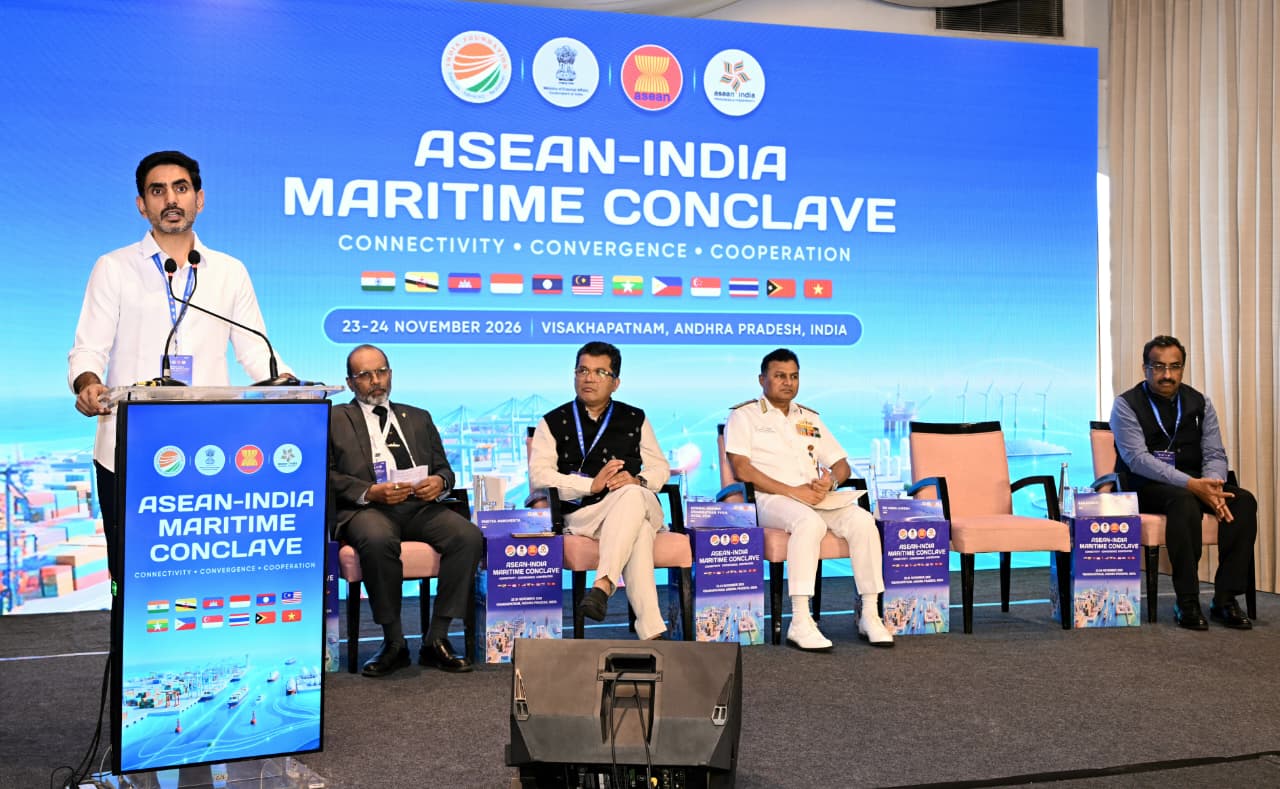
Visakhapatnam, November 23, 2026 : Andhra Pradesh wants strong and lasting maritime partnerships with the countries of Southeast Asia and is ready to work with them on maritime connectivity, technology, clean energy and skill development, said Nara Lokesh, Minister for HRD, IT & Electronics, Government of Andhra Pradesh.
He was speaking as chief guest at the ASEAN–India Maritime Conclave (ASEAN is the Association of Southeast Asian Nations), organised by India Foundation in partnership with the Ministry of External Affairs at the Novotel hotel in Visakhapatnam. Union Minister of State for External Affairs Pabitra Margherita also attended.
“Visakhapatnam has a great maritime history. It is home to the headquarters of India’s Eastern Naval Command, and today it is also growing into an important centre for trade and technology. Our ties with Southeast Asia go back centuries. Long before modern transport, traders and scholars travelled between our coasts, exchanging goods, knowledge and culture. Ancient ports such as Kalingapatnam and Machilipatnam played a key role in these ties. The sea was once our first highway. Today, through modern ports, digital technology and clean energy, we have the chance to make that bond even stronger. That is why this conclave chose the theme Connectivity, Convergence, Cooperation,” said Nara Lokesh, Minister for HRD, IT & Electronics, Government of Andhra Pradesh.
Priority for the maritime economy
Lokesh said that under Prime Minister Narendra Modi’s leadership, India is giving new priority to its ocean-based economy. Through Sagarmala (the Centre’s port-led development programme), Maritime India Vision 2030 and Maritime Amrit Kaal Vision 2047, investments are being made in better ports, shipbuilding, transport and cargo-handling infrastructure. The Union Cabinet has approved a package of about Rs 70,000 crore to strengthen Indian shipbuilding and the maritime sector, including a Rs 25,000 crore Maritime Development Fund.
About 95% of India’s trade by volume moves by sea, he said, so better ports and shipping infrastructure are essential for economic growth. Every new port creates new opportunities for industries, businesses and young people.
Progress through cooperation
At the recent India–ASEAN Summit in Manila, Prime Minister Modi proposed a long-term maritime cooperation plan covering connectivity, research, disaster management and maritime security, and stressed growing together through cooperation. Lokesh said Andhra Pradesh is ready to play its part in realising this vision.
A long coastline, a big advantage
Andhra Pradesh has a coastline of about 1,053 km, one of the longest in India. Under Chief Minister N. Chandrababu Naidu’s leadership, the State is working to become a major maritime and industrial gateway.
Visakhapatnam Port handled a record 91.17 million tonnes of cargo last financial year, growth of about 10%. Four new ports are under construction at Ramayapatnam, Mulapeta, Machilipatnam and Kakinada. They will improve transport connectivity and support industries in Andhra Pradesh and neighbouring states.
The State has proposed a major shipbuilding cluster at Dugarajapatnam with an investment of about Rs 30,000 crore. Just last week, five maritime MoUs worth about Rs 7,500 crore were signed in Visakhapatnam, covering port expansion, logistics, specialised terminals and ship repair. “Our main goal is to connect ports with industries, and industries with global markets,” Lokesh said.
Visakhapatnam as a digital connectivity centre
Digital connectivity is becoming central to the ocean economy, and Visakhapatnam is emerging as a key centre for it, Lokesh said. Google has announced a $15 billion investment in Visakhapatnam to build a gigawatt-scale AI hub, data centres and international subsea cable connectivity. Three international subsea cables will land in the city. The foundation stone has been laid for Visakhapatnam’s first open cable landing station, being developed by Sify at Rushikonda.
He recalled that at the AI Impact Summit in New Delhi earlier this year, Google CEO Sundar Pichai shared that as a student he had passed through Visakhapatnam on the Coromandel Express and remembered it as a calm coastal city full of potential. Pichai said he never imagined then that it would become a global AI hub. “Today we are turning that possibility into reality,” Lokesh said.
Sri City and Tirupati as electronics manufacturing hubs
“The seas that carry our trade are now also the routes for the subsea cables that connect the digital world. As IT and Electronics Minister, I see huge potential in using AI and digital technology at our ports. Smart ports can cut delays, improve safety and make logistics more efficient,” said Nara Lokesh, Minister for HRD, IT & Electronics, Government of Andhra Pradesh.
He said the State is also strengthening electronics manufacturing at Sri City and Tirupati, and construction has begun on a semiconductor assembly and testing facility under the India Semiconductor Mission at Tarluvada near Visakhapatnam. With strong ports, better digital infrastructure and growing manufacturing, Andhra Pradesh can become an important partner in ASEAN supply chains.
Making AP the Saudi Arabia of green energy
Clean energy is another major opportunity for Andhra Pradesh, which has huge potential in solar, wind and pumped storage power (which stores energy by pumping water uphill and releasing it to generate power when needed). The State aims to become a leading exporter of green hydrogen and green ammonia, and to become the Saudi Arabia of green energy by using sunlight, wind and technology to produce clean fuel.
AM Green has signed an agreement to supply about 70,000 tonnes of green ammonia a year from its Kakinada plant, once it starts operating, to Japan’s JERA. Lokesh said this shows how clean energy produced in Andhra Pradesh can reach global markets through its ports, and the State welcomes similar partnerships with ASEAN countries in green fuels, clean shipping and sustainable port development.
Target of 5,000 maritime professionals by 2028
“Creating jobs through investment is what matters most to us,” Lokesh said. The AP Maritime Policy sets a target of training 5,000 maritime professionals by 2028. The State wants to prepare its ITIs, Andhra University and other institutions to give young people jobs in shipbuilding, marine engineering, logistics and maritime technology.
The State is working with Sagar Defence Engineering to develop unmanned maritime systems at Juvvaladinne, and has invited the company to explore setting up a skill development centre there in partnership with IIT Tirupati and Andhra University. These technologies will improve maritime security and port protection and also help fishermen.
Four areas for cooperation
India and ASEAN already share strong historical and economic ties, and now is the right time to turn them into more business partnerships and technology projects, Lokesh said. Andhra Pradesh is ready to work with ASEAN countries in four main areas: maritime connectivity, through better shipping routes and port logistics; technology, including smart ports, AI, digital logistics and ocean robotics; green energy, through clean fuels and sustainable shipping; and skill development, through partnerships between universities, training institutions and industry.
“I invite business leaders, researchers and delegates from ASEAN countries to come to Andhra Pradesh, visit our ports, meet our industry, see our technology ecosystem and discover the opportunities here for themselves,” said Nara Lokesh, Minister for HRD, IT & Electronics, Government of Andhra Pradesh.
Speed of Doing Business
Under Chief Minister Chandrababu Naidu’s leadership, Andhra Pradesh is moving from ease of doing business to speed of doing business, with faster decisions, better coordination and a focus on turning investment proposals into real projects on the ground.
“We welcome partners who come with technology, investment and new ideas, and we are ready to work with them to make those ideas real. Let us not limit our partnership to meetings and agreements. Let us build something great together,” Lokesh said.
Looking forward to lasting partnerships with ASEAN
“For centuries, the Bay of Bengal has connected India and Southeast Asia. Today it offers new opportunities in trade, technology, clean energy and investment. Visakhapatnam is no longer just a port city. It is emerging as India’s gateway to the East, for trade, technology, investment and innovation. Centuries ago, our seas connected civilisations. Today, the same seas can connect economies, create jobs and bring prosperity. Let us make the Bay of Bengal not just a shared sea, but a shared platform of opportunity for India and ASEAN,” said Nara Lokesh, Minister for HRD, IT & Electronics, Government of Andhra Pradesh.
He thanked the Ministry of External Affairs and India Foundation for organising the conclave.
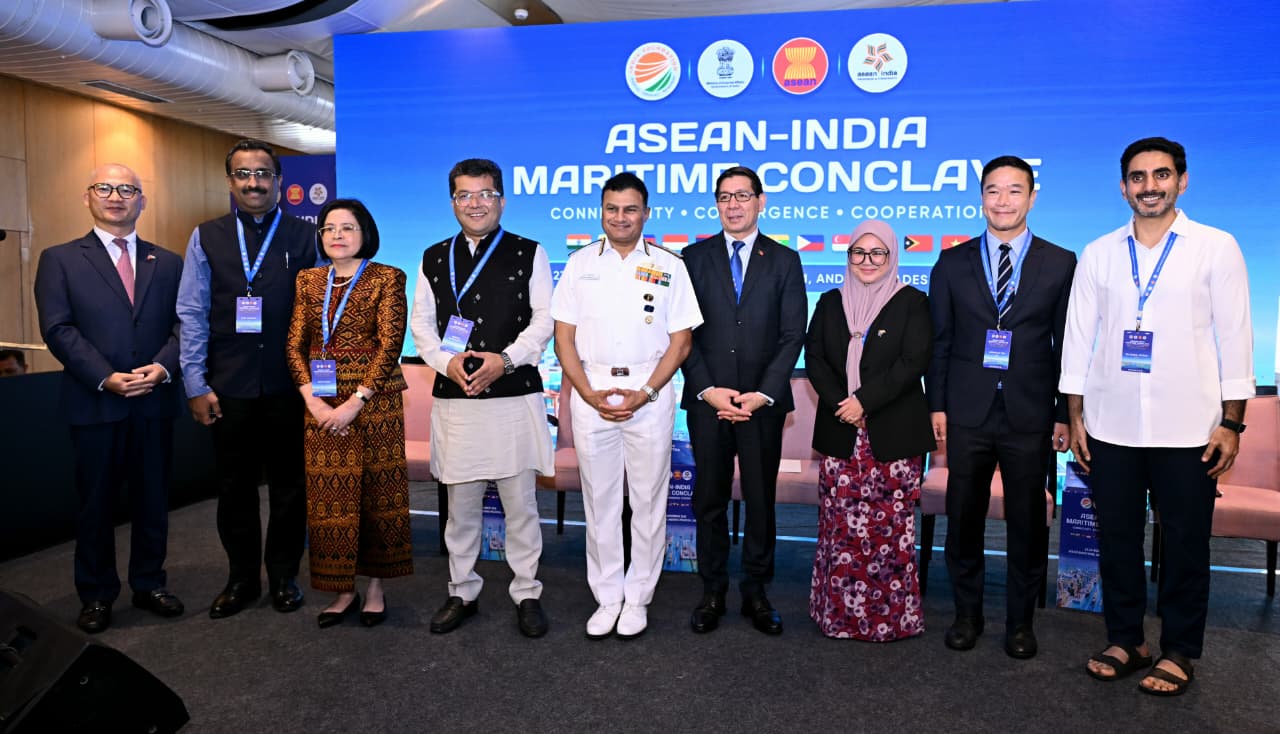
India Foundation President Dr. Ram Madhav, Chief of the Naval Staff Admiral Krishna Swaminathan, former Chief of the Naval Staff Admiral Dinesh Kumar Tripathi, ambassadors of various countries and ASEAN delegates attended the event.
Related News

Classic Legends Turns Profitable in FY26 as Jawa, Yezdi, and BSA Post 55% Overall Growth

Allu Arjun’s Heartwarming Birthday Wish for Daughter Allu Arha Offers a Glimpse of His Family-Man Side
‘The Lakshman – Untold Story’ – A New Experiment in Indian Cinema
AP Rare Earth Development Corporation to be established soon
APSPDCL Superintending Engineer Reviews Power Supply at Sri City