
Protest in a Democracy is Another Form of Dialogue: Key Remarks by Mohan Bhagwat
- Published By: Tech Team
- August 7, 2026 / 09:05 AM IST


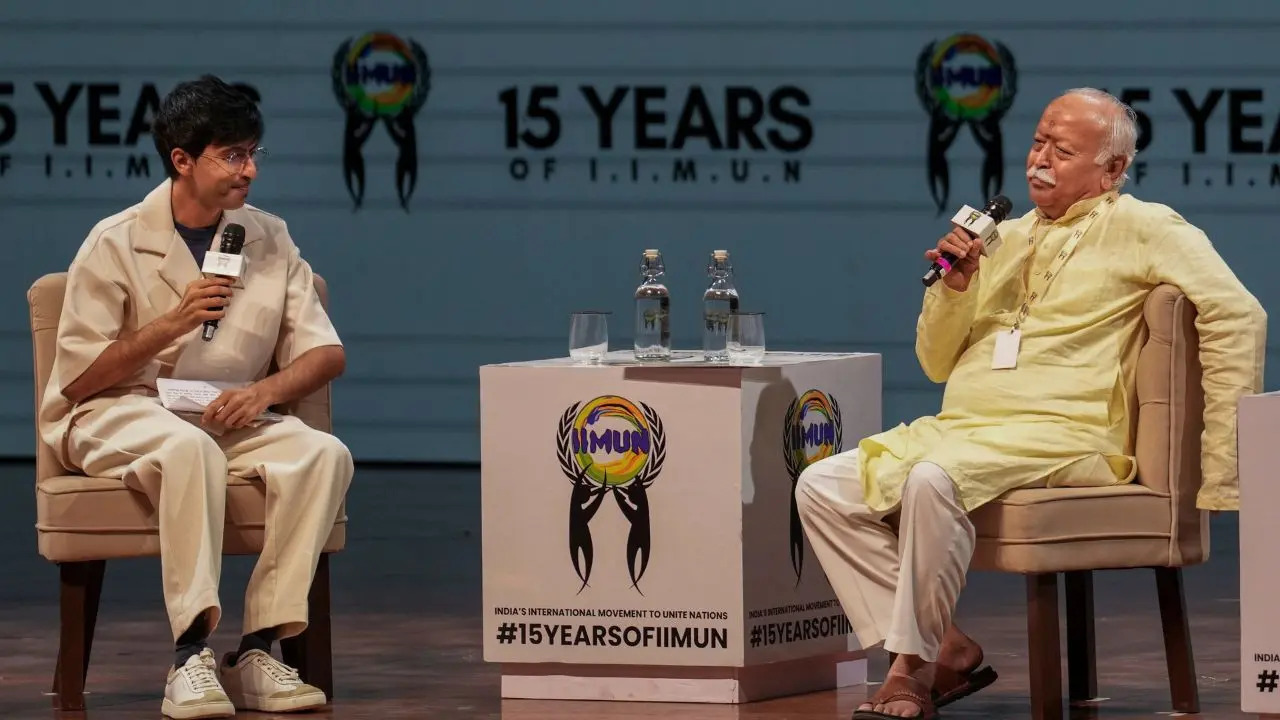
RSS Chief Mohan Bhagwat made several crucial remarks regarding Gen Z, protests, and social movements. He attended the 15th anniversary event of “India’s International Movement to Unite Nations” in Mumbai as the chief guest, an event attended by a large number of Gen Z youth.
Speaking on the occasion, Bhagwat described protest in a democracy as another form of dialogue. He stated that protests should aim to build consensus rather than lead to differences and division. However, if a solution is not reached even after discussions, one may resort to protest, provided it does not lead to divisive methods. Bhagwat clarified that he was not asking Gen Z to refrain from protesting, adding that the Constitution itself outlines how and what should be done in this regard. He cited the guidelines proposed by Dr. B.R. Ambedkar across two of his key speeches on the matter.
He noted that the issues raised by Gen Z are valid, emphasizing the need for significant reforms in India’s education system, which he stated are currently lacking. Therefore, dialogue is essential. What steps to take if discussions fail remains a secondary issue, as dialogue must always be the primary duty when differences arise.
Bhagwat recalled that during his youth, his generation would simply listen to their elders without questioning them. While that was the scenario back then, today’s Gen Z asks questions, and answers must be provided to them through a logical framework combined with empathy.
Addressing the concept of discussion, he noted that while it is called “debate” in English, the Indian tradition refers to it as “Shastrartha” (scholarly debate). In Shastrartha, instead of argument and counter-argument, the approach consists of Poorva Paksha (presenting the opposing viewpoint) and Uttara Paksha (refuting it with reasoning). All perspectives are heard, giving rise to new dimensions. Though diverse viewpoints and counter-arguments emerge, the ultimate truth is eventually revealed.
Bhagwat called on society and institutions to understand the aspirations of Gen Z, urging that genuine concerns be addressed through dialogue and responsible governance. He asserted that any protest must be conducted with appropriate intent, method, and dignified conduct. When Gen Z voices its opinions, it should not be viewed merely as opposition; rather, their challenges should be understood with empathy, and resolving them is the responsibility of society and the system.
He advised the thoughtful use of social media, suggesting the need for rules and self-discipline, while emphasizing that success depends on a shift in mindset. Asking what good laws do when issues persist, he remarked that society itself is the ultimate law. Speaking on role models, he mentioned that each generation naturally adopts different role models over time.
“For instance, what is my position on social media? If a million people follow what I do, it is my responsibility to ensure that my actions do not put those million people in harm’s way. I must possess at least that level of awareness. That is wisdom,” Bhagwat said.
He further noted that social media technology has advanced rapidly, reaching a point where it can create lookalike photos, mimic voices, and make it seem as though people said things they never actually uttered (such as deepfakes). In light of this, he urged users to verify information through reliable sources before believing it, emphasizing that nothing should be trusted without verification.
Bhagwat also suggested that discussions with Pakistan and China should continue when there are no active conflicts, stating that permanent hostility and hatred are improper. Responding to the topic of homosexuality, he stated that necessary social and legal regulations should be framed for same-sex couples, warning that damaging the existing institution of marriage without alternative arrangements could lead to negative consequences.
Related News
India wins the bid to host UCI Road World Championship 2032 in Pune
Keystone STEM Alliance: A Youth-Led Model Transforming STEM Education and Community Engagement
Blueband Sports Rally of Coimbatore Set to Host Round 2 of INRC 2026 with 64 Cars on the Grid
Thanks To Telugu Audience for Making Mandaadi a Blockbuster: Soori
Govt. of West Bengal participates in Walmart Vriddhi MSME Connect 2026 in Kolkata