
A 15-Second Video Didn’t Just Go Viral. It Scared Hollywood.
- Published By: Tech Team
- August 21, 2026 / 04:15 PM IST


— Surya Prakash Josyula
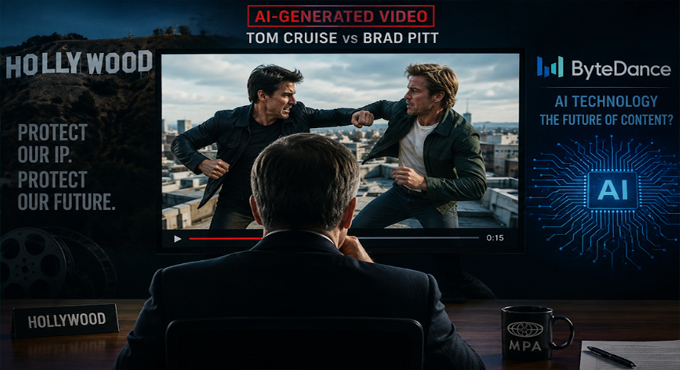
Two men are fighting on the rooftop of a building. One looks like Tom Cruise and the other looks like Brad Pitt. The camera moves around them, their movements look natural, and even their facial expressions and small body movements feel real.
Many people may have already seen this video. At first glance, it looks like a scene from a Hollywood action movie. But there is one surprising fact: the fight never happened.
Tom Cruise and Brad Pitt never shot that scene together. It was not filmed for any movie. The entire sequence was created using AI.
The video was made with ByteDance’s Seedance AI video model and quickly went viral on social media. For many viewers, it was simply another impressive example of what AI can do.
But Hollywood saw something much bigger.
Why Did It Scare Hollywood?
For Hollywood, the video showed that an old boundary was suddenly disappearing. Until recently, a scene like this required actors, cameras, locations, stunt teams, VFX artists and a huge production budget.
Now, if an AI model can create a similar scene from a simple prompt, a much bigger question comes up: where do the rights of actors, studios and creators begin and end?
That question is now forcing Hollywood and AI companies to sit at the same table.
The Real Problem Is Bigger Than the Video
The biggest issue was not simply Tom Cruise or Brad Pitt. The video demonstrated a much more powerful ability of AI.
Creating a fictional person who looks like a real actor is one thing. But using the face of a famous actor and placing that person in a scene the actor never performed is something completely different.
That is where three major issues come together — copyright, likeness and intellectual property.
For Hollywood studios, movies, characters and franchises are not just creative works. They are valuable intellectual property worth billions of dollars.
So if an AI system uses a famous character, movie content or a celebrity’s likeness without permission and creates something new, the obvious question is: who owns it?
This is not only a legal problem. It could become one of the biggest business challenges for the film industry.
Hollywood Responds
As AI videos made with Seedance and other models started gaining attention, the Motion Picture Association (MPA) stepped into the discussion.
Hollywood also understood something important. AI cannot simply be stopped. But AI can have rules.
That is why pressure grew on AI companies to create stronger safeguards against the unauthorized use of copyrighted characters, existing content and the likeness of famous people.
And this is not a problem faced by ByteDance alone. Similar debates are already emerging around other AI video models.
As these systems become more powerful, one question is becoming increasingly difficult to answer: what is inspiration, and what is infringement?
ByteDance Did Not Walk Away
This is where the story takes another interesting turn. ByteDance did not abandon Seedance because of the controversy. Instead, the company continued investing in AI video technology.
With companies such as Google and OpenAI competing in the AI video space, ByteDance also sees Seedance as an important product for the future.
The company’s calculation is fairly simple. AI video is going to be a major part of the future.
But constantly fighting with Hollywood is not good for business either. So the relationship is slowly moving from confrontation towards cooperation.
From Conflict to Talks
After months of discussions between the MPA and ByteDance, the two sides eventually reached a Memorandum of Understanding (MOU).
Under the agreement, ByteDance will work with the MPA to create stronger safeguards around Hollywood intellectual property across its AI technology and platforms.
The framework is not limited to Seedance. It also covers products and platforms such as Seedream 5.0 Lite, TikTok, CapCut and Dreamina.
AI Has Entered Hollywood
The bigger story is not really about one viral video.
AI is no longer a technology standing outside Hollywood. It has already walked through the gates.
Hollywood’s challenge now is not how to keep AI outside. It is how to decide where the boundaries should be once AI is inside.
And perhaps that entire change was captured in just 15 seconds of a viral video.
Related News
Dead Souls: How a 184-Year-Old Classic Was Reimagined for 2026
Studio Ghibli Has Built a Magical World. What Happens Next?
Decapitations? Fine. Gore? Fine. Sex? Nope. China’s Tarantino Problem
Ramayana: Rama Must Win in China, Not Just India! Is China the Real Target of Nitesh Tiwari’s ₹4,000-Crore Epic?
Jo Sharma Receives NAFA Recognition Award from Actor Ajinkya Deo at NAFA North American Film Festival, California