
Harmonising Bike Taxis in India A CUTS International Report Blueprint for Urban Mobility
- Published By: Vishal
- July 22, 2026 / 05:51 PM IST


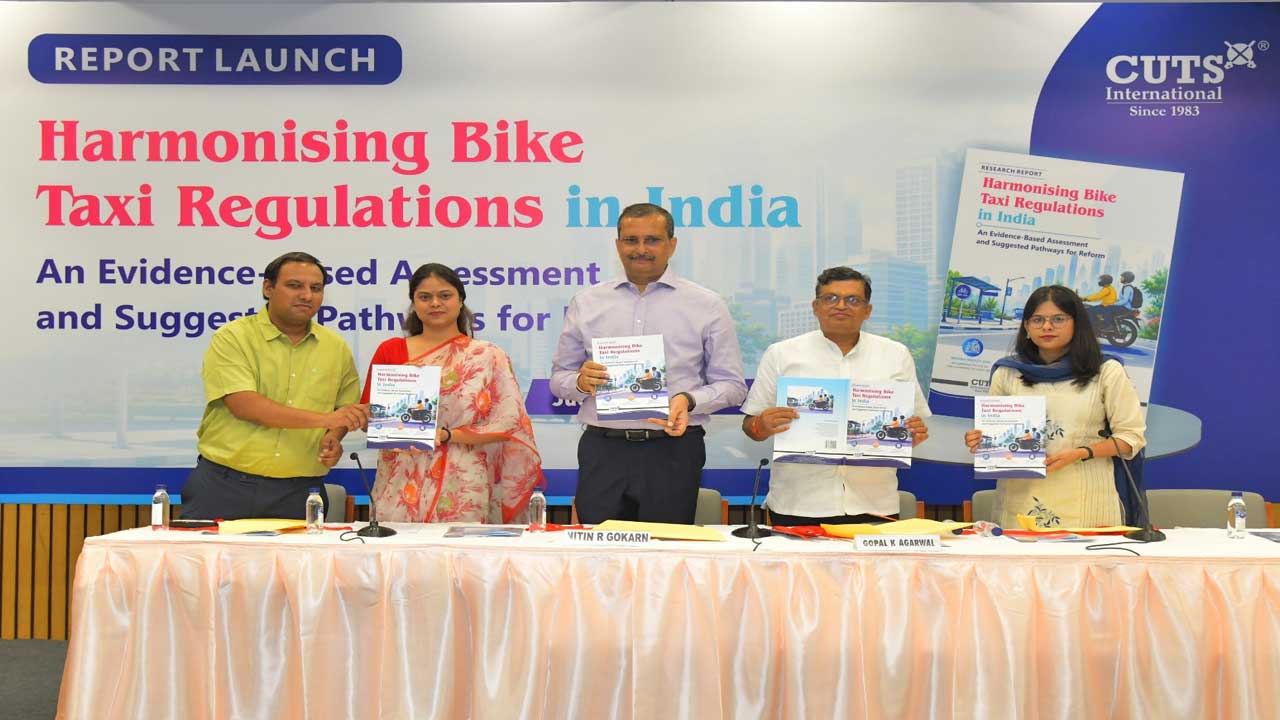
India requires a harmonised, evidence-based, and proportionate regulatory framework for bike taxis to address fragmented state-level implementation, protect gig worker livelihoods, improve first- and last-mile connectivity, and ensure commuter safety, according to a new report by CUTS International. The report, titled “Harmonising Bike Taxi Regulations in India: An Evidence-Based Assessment and Suggested Pathways for Reform,” was launched in New Delhi by Gopal Krishna Agarwal, National Spokesperson for Economic Affairs, Bharatiya Janata Party. At the launch, Agarwal emphasized that an integrated mobility ecosystem can serve as a vital driver of connectivity, employment, productivity, and sustainable growth. The report highlights that divergent state approaches ranging from enabling frameworks and conditional permissions to restrictions, EV-only mandates, and legal uncertainty have created significant unpredictability for commuters, gig workers, platform aggregators, and regulators alike.
Key Findings of the CUTS Report:
The comprehensive assessment outlines several critical insights regarding the role and challenges of bike taxis within India’s urban landscape:
Essential Urban Connectivity: Bike taxis have emerged as a structurally important part of India’s urban mobility ecosystem by bridging first- and last-mile connectivity gaps, complementing public transport, and enhancing access to metro and bus networks for short-distance travel.
Existing Legal Foundation: The legal foundation for motorcycles used for hire already exists under the Motor Vehicles Act, 1988, and is guided by the Motor Vehicle Aggregator Guidelines, 2025, issued by the Ministry of Road Transport and Highways, with the primary challenge lying in coherent state-level implementation.
Regulatory Divergence: Studies across Delhi, Kerala, Maharashtra, Rajasthan, Tamil Nadu, and West Bengal reveal that identical services are permitted in some jurisdictions and restricted in others, increasing compliance burdens and pushing disputes toward judicial intervention.
Affordability and Demographics: Bike taxis typically cost ₹8–10 per kilometre compared to ₹15–18 for auto-rickshaws and ₹22–25 for regular taxis, making them exceptionally relevant for students, informal workers, young professionals, and peri-urban commuters.
Low-Barrier Livelihoods: Two-wheelers provide youth, migrants, and informal workers with flexible livelihood opportunities involving low upfront investment, yielding average monthly net incomes of ₹25,000–30,000 after operating expenses.
Burden of Mandatory Conversion: Permanent conversion of private motorcycles into transport vehicles imposes disproportionate financial and procedural hurdles such as re-registration costs, higher insurance premiums, and fitness certifications which disproportionately affect part-time workers.
Sustainability and EV Transition: While supporting electrification, the report recommends incentive-based policies and phased timelines rather than immediate internal combustion engine exclusions, noting that EV mandates without adequate charging infrastructure create unnecessary entry barriers.
Strategic Recommendations for Reform:
Based on its findings, the CUTS report advises state governments to transition away from blanket prohibitions and adopt structured operational guidelines. Key recommendations include:
Operationalising the 2025 Motor Vehicle Aggregator Guidelines through notified state schemes.
Allowing the aggregation of non-transport motorcycles subject to defined safety, insurance, and compliance conditions, while adopting platform-authorised usage models instead of mandatory permanent commercial conversions.
Creating period-specific permit frameworks and lightweight compliance models to regulate market scale, prevent excessive saturation, and generate predictable revenue streams without imposing high upfront costs on drivers.
Harmonising baseline safety and welfare standards including mandatory health and accident insurance for drivers and passengers, helmet enforcement, transparent fare-setting frameworks, and accessible grievance redressal mechanisms.
Expert Insights and Stakeholder Discussions:
Delivering a special address at the launch, Nitin R. Gokarn, Chairman of the National Road Safety Board, observed that innovation often moves faster than regulation, necessitating timely policy evolution to support safe and accountable growth in emerging mobility sectors. The event featured two prominent panel discussions: the first, titled “Harmonising Regulation Across States: Bridging Policy Gaps and Legal Ambiguities,” was moderated by Amol Kulkarni (CUTS International) and featured industry experts from Chiral Consulting, Uber India and South Asia, IIIT Delhi, Rapido, and Chase Advisors. The second panel, “Bike Taxis in India’s Mobility Ecosystem: Innovation, Livelihoods and Consumer Welfare,” was moderated by Anil Sasi (The Indian Express) and included representatives from the Government of Rajasthan, PLR Chambers, Rapido, and the Council on Energy, Environment and Water. These discussions underscored that a harmonised, evidence-based framework is essential to balance commuter safety, worker welfare, innovation, and consumer choice.
Related News

BenQ Unveils “MOBIUZ Game Art Museum” Experience at Tokyo Game Show 2026

Dreame Technology Launches Flagship X60 Ultra Complete Robot Vacuum in India

Turtle Wax Marks 80 Years of Global Leadership as CEO Laurie King Visits India to Accelerate Expansion Plans

Hyundai Motor India Opens Bookings for the New Intelligent Utility Vehicle, Hyundai BAYON

Telangana AI Summit 2026 Drives State’s Vision to Become a Global Artificial Intelligence Hub