


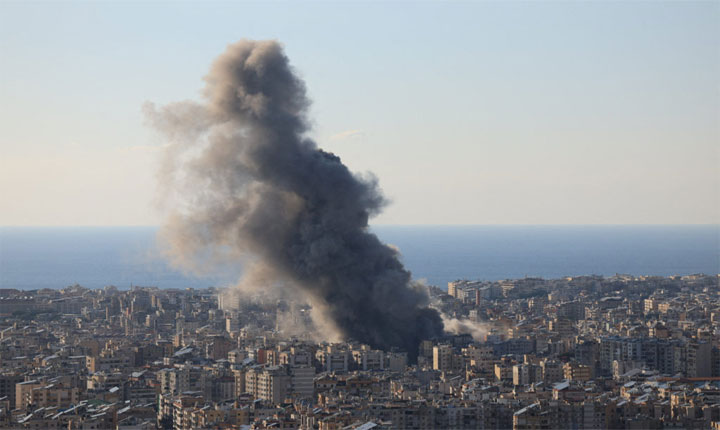
How conflict — more than any other crisis — hammers a country’s economic output, and why that affects you even when the war is far away:
Most of us have probably never lived through a war. But what happens to a country’s economy when one breaks out? Turns out, conflict is one of the most destructive forces an economy can face — even worse than a natural disaster.
The International Monetary Fund (IMF) — the organization that tracks the health of economies around the world — recently studied how different kinds of crises hurt a country’s economic output. Economic output, also called GDP, is basically the total value of everything a country produces: goods, services, jobs. When it shrinks, people lose work, prices rise, and everyday life gets harder for all of us.
War Hits Hardest — and the Damage Grows Over Time:


According to IMF calculations, a conflict on a country’s own territory will decrease its economic output by almost 3 percent on average just one year after the conflict starts, and by almost 7 percent five years later.
Imagine our family’s income dropped by 7%. That’s like losing roughly one month’s pay, every single year.
What makes this especially striking is that conflict damage compounds over time. A banking crisis or a natural disaster is bad, but economies tend to bounce back. Wars, on the other hand, destroy infrastructure, displace people, and scare away investment — damage that keeps accumulating long after the fighting starts.
How Conflict Compares to Other Crises:
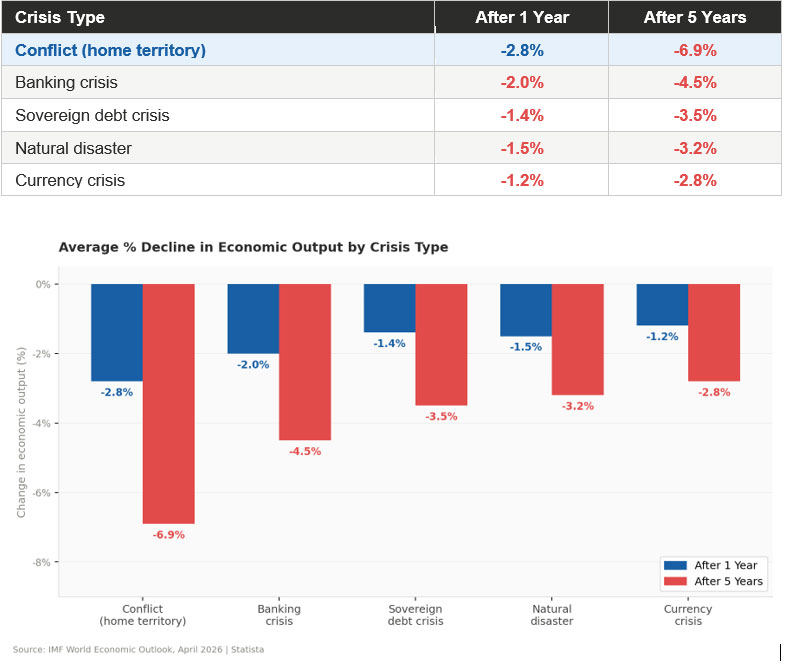

Comparison figures for banking, sovereign debt, natural disaster, and currency crises are IMF historical averages. Conflict figures confirmed by IMF World Economic Outlook, April 2026.
We Don’t Have to Be Fighting to Feel the Pain:
Here’s something surprising: even countries that are not being attacked feel economic consequences. Attacking countries that did not have conflict on their own territory still suffered economic consequences — about 0.1 percent after one year and 1.6 percent after five years. Neighboring countries were affected at around a loss of 1.2 percent, while trading partners suffered a decline of 0.6 to 1.2 percent depending on how long the conflict dragged on.
Think of it like a car crash on a highway. We might not be in the crash, but if it’s blocking the road we use every day, we’re still going to be late for school.
Internal Conflicts Are Especially Damaging:
The analysis found that shorter conflicts were usually more intense and therefore more harmful to the economy. The same was true for internal conflicts — like civil wars or uprisings inside a country — which did slightly more damage than conflicts between countries. When a country is fighting itself, there’s no safe corner of the economy to retreat to.
Why Does This Matter to Us?
Right now, there are active conflicts in multiple parts of the world. The IMF recently downgraded its projections for global GDP growth because of the war in Iran. That affects oil prices, food costs, and supply chains that touch things we use every single day — from the gas in our family’s car to the price of groceries.
Source: Statista / IMF World Economic Outlook, April 2026. statista.com/chart/36092/decline-economic-output-if-crises-happen/
By Shiva Duvvuru, CPA. email: admin@taxcircle.com